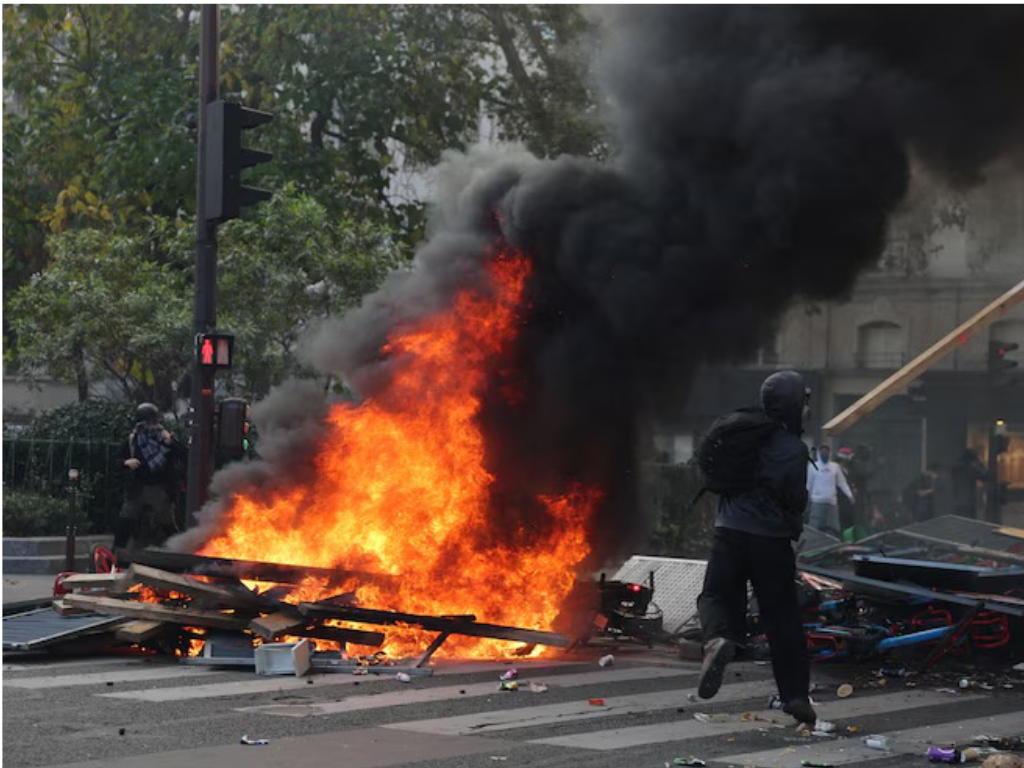
France Is Burning : Protestors and police clash in Paris, Lyon, Marseille, buildings burnt, shops looted, where is Macron?

France’s latest wave of violent protests exposes a growing contradiction in European politics: governments are preparing to spend more on defence while citizens struggle with living costs, deteriorating public services and uncertainty over their economic future.
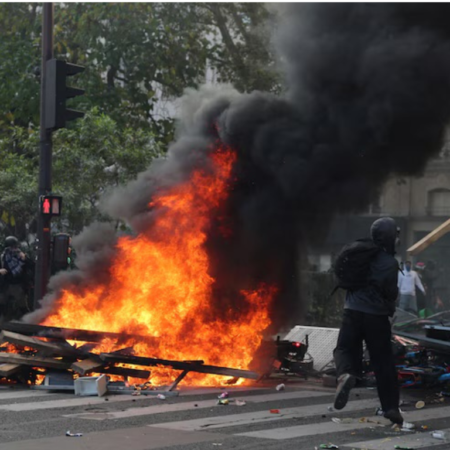
France is once again confronting a crisis that extends far beyond the streets of Paris. On October 17, tens of thousands of people demonstrated across the country against rising prices, public spending cuts, teacher shortages and declining living standards. In several cities, the demonstrations descended into violence. Police used tear gas and water cannons, a tourist office in Lyon caught fire, and public buildings and shops were damaged in Marseille. The Interior Ministry reported 272 arrests by mid-afternoon. Reuters reported the unrest as one of the country’s most intense protest episodes in years.
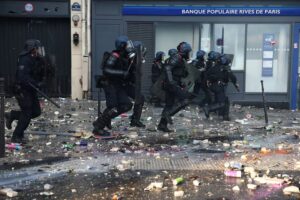
The immediate triggers are familiar: expensive fuel, pressure on household budgets, dissatisfaction with public services and anger over spending cuts. But beneath these grievances lies a larger strategic question. As Europe attempts to assume greater responsibility for its own security, can its governments finance a more heavily armed continent without further alienating the people who must pay for it?
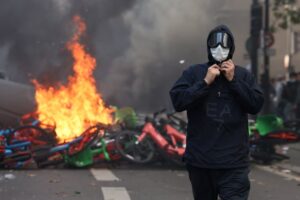
For President Emmanuel Macron, the challenge is increasingly political as well as economic. His government must contend with public anger, fiscal constraints and a changing security environment at a time when confidence in political leadership is under pressure.
Europe Is Rearming, but Who Pays the Price?
The European security landscape has changed dramatically since Russia’s invasion of Ukraine in 2022. The war exposed weaknesses in Europe’s military preparedness, ammunition stocks and defence-industrial capacity. It also reinforced the argument that European NATO members could no longer depend so heavily on American military power.
US President Donald Trump has repeatedly demanded that European allies shoulder a greater share of NATO’s defence burden. The pressure has now translated into a formal alliance commitment.
At the June 2025 NATO summit in The Hague, allies agreed to work towards investing 5% of GDP annually in defence and defence-related security by 2035. This includes at least 3.5% of GDP for core military requirements and up to 1.5% for broader security-related investments. According to NATO, European allies and Canada increased their combined defence expenditure by nearly 20% in real terms in 2025 compared with 2024. NATO’s defence investment figures illustrate the scale of this shift.
For European governments, the strategic argument is compelling. Russia remains a security concern, the war in Ukraine continues to shape defence planning, and uncertainty about the long-term scale of American support has strengthened calls for European strategic autonomy.
Yet strategic necessity does not eliminate the fiscal consequences.
Every government must make choices about taxation, borrowing, public investment and competing expenditure priorities. Defence budgets do not automatically rise at the expense of welfare, education or healthcare; countries can also raise revenues, borrow within fiscal constraints, improve efficiency or stimulate economic growth. Nevertheless, when governments simultaneously promise stronger armed forces, lower deficits and restrained public expenditure, the pressure to reconcile those competing objectives becomes intense.
The political danger is that citizens begin to see national security as an expensive priority that offers them little relief from the problems of everyday life.
From Defence Budgets to Empty Classrooms
The French protests began with student concerns over teacher shortages and inadequate school facilities before expanding into broader opposition to the cost of living and public spending cuts.
That progression matters.
When students protest because their schools lack sufficient teachers, workers complain about rising fuel prices, and households struggle to maintain their living standards, the issue is no longer confined to a single policy failure. It becomes a question of whether the state is delivering the services citizens believe they are entitled to receive.
Europe’s rearmament drive risks intensifying this question if governments fail to explain how their security commitments will coexist with domestic priorities.
A modern military is essential to protecting a country against external threats. But national resilience also depends on functioning schools, accessible healthcare, reliable transport, affordable energy and a productive workforce. A country cannot indefinitely neglect its social foundations while expecting its population to support an increasingly expensive security architecture.
Nor should defence spending and social spending automatically be treated as mutually exclusive. A stronger economy, better-targeted expenditure and more effective public administration can help finance both. The real test is whether political leaders can produce credible budgets that distribute the burden fairly rather than leaving ordinary households to absorb the consequences.
For France, where public services have long occupied an important place in the social contract, the perceived deterioration of those services can become particularly combustible.
Macron’s Political Dilemma: Strategic Ambition, Domestic Discontent
Macron has consistently argued for a stronger European role in defence and a more strategically autonomous Europe. The logic is understandable: a continent that wants to influence international affairs must possess the military capabilities to defend its interests.
But strategic ambition cannot insulate a president from domestic economic pressures.
The current unrest recalls the Yellow Vest movement that erupted in 2018 over fuel taxes and subsequently broadened into a revolt against economic hardship, inequality and political alienation. That episode demonstrated how a measure presented as economically or environmentally justified can become a symbol of unfairness when citizens believe the costs fall disproportionately on them.
The latest demonstrations carry a similar warning. People may accept the argument that Europe faces serious security threats, yet still question why they should endure higher living costs, reduced public services or greater financial uncertainty without a clear explanation of the government’s priorities.
This is where Macron’s political credibility faces a serious test. The government must explain not only why France needs stronger defence capabilities, but also how it intends to preserve social cohesion while pursuing that objective.
There is a further danger for European leaders: when economic dissatisfaction accumulates, it can be exploited by political movements that offer simple explanations for complicated problems. Governments that fail to address legitimate grievances create opportunities for polarisation, populist mobilisation and deeper distrust of democratic institutions.
Macron cannot resolve this challenge through rhetoric about European unity alone. Citizens must see evidence that national security and domestic prosperity remain complementary objectives.
Not Every Protester Is a Radical, but Violence Cannot Be Excused
The violence accompanying the demonstrations presents a separate and equally serious problem.
Fire, vandalism, damage to shops and public buildings, and confrontations with police is not anybody right, it’s hooliganism. The reported breach of Marseille’s town hall and the burning of Lyon’s tourist office illustrate how unrest can move beyond political expression into the destruction of public property. Such acts must be condemned and addressed through lawful policing and prosecution.
Public frustration does not confer a right to burn buildings, loot businesses or attack public institutions. These actions endanger lives, impose financial costs on taxpayers and workers, disrupt local economies, and frequently undermine the very causes protesters claim to represent.
However, it would be equally misguided to characterise every demonstrator as a radical or to treat the entire movement as violent. The protests encompass people with different concerns, including students, workers and citizens dissatisfied with economic conditions.
The French Interior Ministry’s attribution of violence to the far left or “ultra-left” should be understood as the government’s assessment and reality behind the protest. Authorities must distinguish peaceful assembly from criminal conduct. Those responsible for arson, assaults and organised vandalism should face proportionate legal consequences. Effective law enforcement is necessary to restore order.
The Cost of Rearmament Is Also a Test of Political Leadership
Europe’s strategic predicament cannot be reduced to a choice between guns and butter. The continent faces genuine security concerns, and postponing military investment indefinitely could leave it vulnerable to coercion or aggression.
But the reverse is also true: military preparedness cannot compensate for a population that has lost confidence in its institutions, feels economically abandoned or believes its government no longer understands its daily struggles.The challenge is to establish a sustainable balance.
First, European governments must be transparent about defence commitments, their costs and the timelines for meeting them. Security policy should not be insulated from democratic scrutiny.
Second, governments must protect essential public services and direct social support towards households most exposed to rising living costs. Defence investment should be accompanied by credible plans for education, healthcare, transport and economic opportunity.
Third, European leaders must strengthen the domestic economic foundations of rearmament. A more productive industrial base, coordinated procurement, reduced duplication and efficient spending can improve military readiness without treating every increase in expenditure as an unavoidable burden on citizens.
Finally, governments must enforce the law consistently. Peaceful protest is a democratic right; arson, looting and attacks on public institutions are not. A state that fails to maintain public order risks allowing violent minorities to dominate national debate.
France’s Warning to Europe
France’s unrest is a warning that European governments cannot pursue strategic transformation while ignoring the domestic conditions that sustain political legitimacy.
The pressure to increase defence spending is real. NATO’s new investment targets reflect a changing security environment and a greater expectation that Europe must take responsibility for its own protection. But citizens will judge their governments not only by military capabilities or international commitments, but also by whether schools function, public services remain accessible and households can afford everyday necessities.
The danger is not simply that protests will continue. It is that the gap between strategic ambition and domestic expectations will widen, weakening public trust and making long-term policy increasingly difficult to sustain.
Macron’s challenge is therefore larger than restoring order in Paris, Lyon or Marseille. It is to demonstrate that a stronger France and a more secure Europe need not come at the expense of a functioning social contract.
Europe cannot build a sustainable security architecture on a foundation of domestic discontent. Rearmament may be necessary, but political legitimacy, economic stability and public confidence are equally essential to the continent’s long-term resilience.