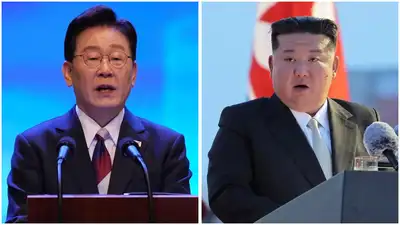

Recently South Korea’s president has proposed talks with its northern neighbour on officially ending the war between the two that is technically still active.
The President Lee Jae Myung suggested a “multi-layered security system” to avoid flare-ups along the countries’ de-facto border, known as the demilitarised zone (DMZ), and offered to discuss practical ways of halting Pyongyang’s nuclear ambitions.
“Let us put down our intentions to threaten each other and begin discussions to end the long-running war as the directly involved parties,” he told a ceremony marking Liberation Day, which commemorates the peninsula’s liberation from Japanese rule.
Lee expressed hope that the two nations “will sit face-to-face for peaceful coexistence and mutual growth”, adding this could serve as a forum for discussing “effective ways to halt the advancement of the North’s nuclear capabilities”.
For more than seven decades, the Korean Peninsula has remained divided by one of the world’s most heavily militarised borders. The Korean War ended in 1953 with an armistice, not a peace treaty, leaving North Korea and South Korea technically in a state of war. Since then, periods of confrontation have repeatedly been followed by attempts at dialogue, only for the relationship to deteriorate again.
These developments are pushing forth an argument that something more fundamental may be happening: the two Koreas could be moving away from the old objective of reunification and, eventually, toward a form of permanent coexistence.
From reunification to two separate states?
One of the most important developments has been North Korea’s changing attitude toward South Korea.
For decades, Pyongyang officially presented reunification as a central national objective. That position has increasingly been abandoned. During 2024, North Korea destroyed sections of roads and railways connecting the two countries and began describing South Korea as a “hostile” and effectively foreign state. The deterioration followed months of balloon campaigns, propaganda warfare and military tensions along the border.
This shift is enormously significant. A permanent peace does not necessarily require North and South Korea to reunify. In fact, if Pyongyang has genuinely abandoned the idea that the two sides must eventually become one country, there may be a different diplomatic possibility: accepting the existence of two Korean states while establishing rules that prevent them from going to war.
That would represent a fundamental change from the traditional Korean peace process.
South Korea is also changing its approach
The election and policies of South Korean President Lee Jae Myung have created another potentially important opening.
Lee has repeatedly called for dialogue with Pyongyang and for replacing the 1953 armistice with a formal peace regime. In July 2026, he said South Korea would continue efforts to engage North Korea and establish a peace regime despite the difficulties involved.
More importantly, Seoul has begun moving away from the idea that North Korea must first completely give up its nuclear weapons before meaningful negotiations can begin.
South Korea’s Unification Minister Chung Dong-young said in July that the government had shifted toward a “peace-first” approach. Rather than making denuclearisation an absolute prerequisite for dialogue, Seoul is looking at peace and tension reduction as steps that could come first, while retaining the long-term objective of denuclearisation.
This is potentially more realistic than demanding immediate denuclearisation.
North Korea has spent years building its nuclear and missile capabilities and increasingly treats its nuclear arsenal as essential to regime security. Expecting Pyongyang simply to surrender those weapons before receiving any security guarantees is therefore unlikely to succeed.
A more gradual approach could involve military confidence-building, crisis-management mechanisms, arms-control measures and eventually negotiations over nuclear risks.
The problem right now is that Pyongyang has simultaneously been strengthening its military position.
North Korea has continued developing missiles and nuclear capabilities, while its relationship with Russia has grown dramatically. Moscow and Pyongyang have expanded military and strategic cooperation, and North Korea has provided support to Russia in its war against Ukraine. Russia, in turn, has become an increasingly important source of diplomatic and potentially technological support for Pyongyang.
North Korea also continues to test missiles. On August 11, 2026, it launched another ballistic missile shortly before the latest U.S.-South Korean military exercises. The launch was the latest in a series of tests and demonstrated that military confrontation remains very much part of Pyongyang’s strategy.
The planned U.S.-South Korean exercises themselves remain a major obstacle. Seoul and Washington describe them as defensive preparations, while North Korea routinely portrays them as rehearsals for an invasion. Pyongyang has again threatened a strong response to the latest exercises.
Could the “two-state” reality actually make peace easier?
Paradoxically, perhaps.
For decades, reunification was treated as the ultimate solution to the Korean question. But reunification is enormously difficult to imagine in practical terms. North Korea and South Korea have developed completely different political systems, economies, societies and international alliances.
North Korea now appears to be moving toward formalising the idea that the two countries are separate states. Reports in 2026 indicated that Pyongyang’s constitutional changes further codified its abandonment of the traditional goal of unification. Seoul, meanwhile, has continued to promote peaceful coexistence despite that development.
This could create an unexpected diplomatic opportunity. If both sides eventually accept that they do not have to absorb or overthrow the other, negotiations could concentrate on much narrower and more achievable goals:
1. preventing accidental military clashes
2. restoring military communication channels;
3. establishing rules around the Demilitarized Zone;
4. reducing artillery and missile risks;
5. creating economic and humanitarian exchanges;
6. establishing a formal peace treaty;
7. developing mechanisms for managing North Korea’s nuclear arsenal;
8. and eventually negotiating arms-control agreements.
Such a settlement would look less like the reunification of Germany and more like a long-term security arrangement between two neighbouring states.
The biggest obstacle: trust
The fundamental problem is that neither government fully trusts the other.
South Korea fears that North Korea’s nuclear weapons, missiles and military forces could be used against it. North Korea, meanwhile, views the U.S.-South Korean alliance and military exercises as evidence that Washington and Seoul ultimately seek regime change.
That mistrust has repeatedly destroyed diplomatic progress.
The experience of 2018 is particularly important. The period produced summits, military agreements and hopes of reconciliation, but the process eventually collapsed. By 2024, many of the mechanisms created during that period had deteriorated or been suspended, while border tensions increased.
A lasting settlement would therefore require incremental confidence-building rather than a single grand agreement.
The nuclear question cannot be avoided
There is also a fundamental difference between a peace agreement and denuclearisation.
It is possible to imagine North and South Korea formally ending the state of war without North Korea immediately abandoning its nuclear arsenal. Indeed, South Korea’s new “peace-first” approach appears to recognise that reality.
But this creates another difficult question: would South Korea and the United States accept a permanently nuclear-armed North Korea?
North Korea’s nuclear programme has become deeply embedded in its national-security strategy. Meanwhile, South Korea is strengthening its own conventional and strategic capabilities. Recent developments, including Seoul’s plans for nuclear-powered submarines, illustrate the broader arms competition taking place across Northeast Asia.
A permanent settlement may therefore have to begin with nuclear risk reduction rather than nuclear disarmament.
Russia and China complicate the picture
Another reason a quick resolution is unlikely is that North Korea is no longer as dependent on South Korea or the United States as it was during previous diplomatic periods.
Its expanding relationship with Russia provides Pyongyang with additional diplomatic and economic options. North Korea is also maintaining important ties with China. This gives Kim Jong Un more room to resist pressure from Seoul and Washington.
Russia and North Korea have been publicly emphasising their growing strategic relationship, including cooperation on regional security.
At the same time, Russia and China could eventually become part of the solution. A durable Korean peace would be much easier to maintain if the major powers surrounding the peninsula — particularly the United States, China and Russia — accepted and supported a new security framework.
So, are the Koreas heading toward a permanent resolution?
Possibly, but probably not in the form people traditionally imagine.
There is little evidence today that North and South Korea are on the verge of signing a comprehensive peace treaty. North Korea continues to test missiles, criticise South Korea and the United States, expand its military capabilities and strengthen its relationship with Russia. As recently as August 2026, Pyongyang was rejecting Seoul’s diplomatic overtures while objecting strongly to U.S.-South Korean military exercises.
Nevertheless, an important transformation may be taking place beneath the surface.
The old vision of reunification is fading. North Korea is increasingly presenting South Korea as a separate state, while South Korea is beginning to consider whether peaceful coexistence between two states can be a realistic intermediate — or even long-term — solution. Seoul’s leadership has explicitly continued to advocate dialogue and a peace regime that may ultimately be more realistic than trying to solve every issue at once.