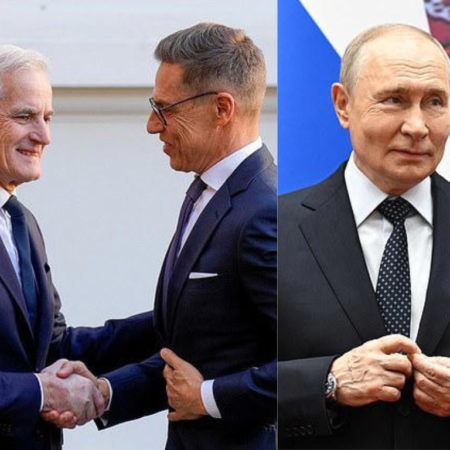
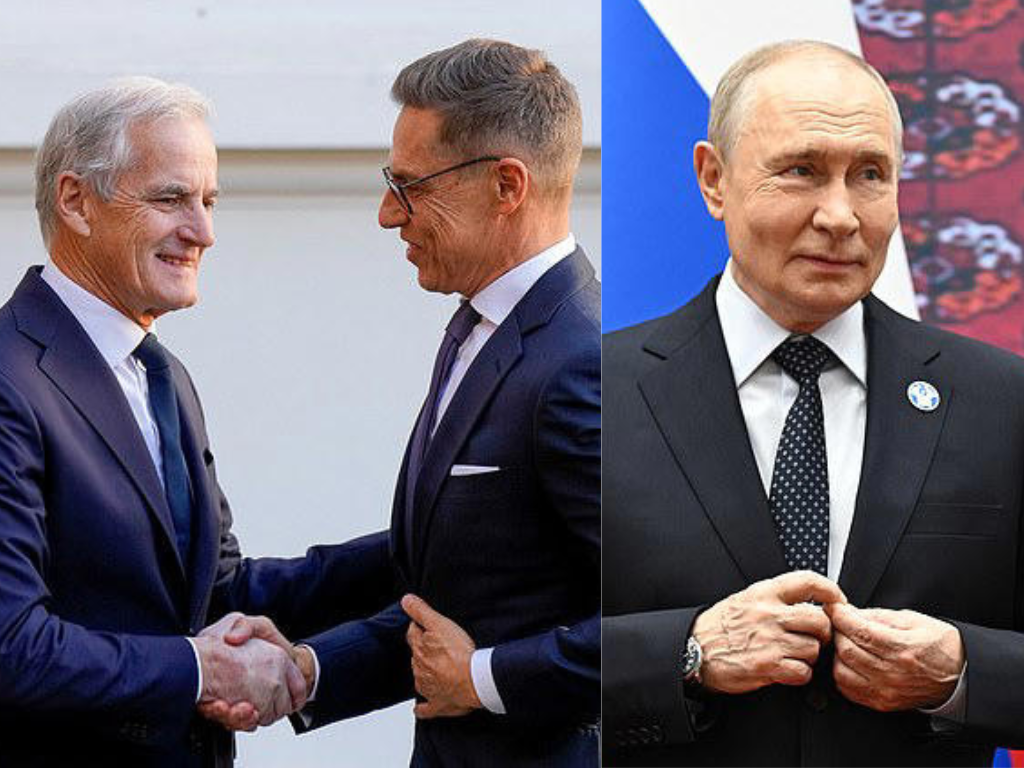

The leaders of Finland and Norway held a 90-minute conversation with Russian President Vladimir Putin, defending direct engagement as necessary to end the war in Ukraine. The move drew criticism from Denmark and Sweden, exposing differences among Nordic allies over how Europe should approach Moscow as fighting continues.
Finnish President Alexander Stubb and Norwegian Prime Minister Jonas Gahr Støre described their Tuesday conversation with Putin as “frank and substantive”, arguing that ending the war requires direct discussions with the Kremlin. The call marked the first direct exchange between Putin and Ukraine’s key European supporters since French President Emmanuel Macron spoke with the Russian leader in July 2025.
However, the outreach triggered criticism from other Nordic leaders, who questioned the lack of coordination and expressed scepticism about the prospects of meaningful progress.
Danish Prime Minister Mette Frederiksen said the call had “not been coordinated with the rest of us”, stressing the importance of maintaining a united European position towards Russia.
“We should be very careful about giving Putin an opportunity that he did not have until a few hours ago,” Frederiksen said, warning against diplomatic engagement that could undermine European unity.
Swedish Prime Minister Ulf Kristersson, speaking at a meeting of Nordic leaders in Helsinki, said he had received no advance notice of the conversation and had limited expectations about its outcome. He reiterated that any peace agreement must be reached on Ukraine’s terms.
Defending the initiative, Støre clarified that he and Stubb had spoken to Putin on behalf of their respective countries rather than representing the Nordic bloc as a whole.
“We stressed the importance of de-escalation,” Støre said, acknowledging significant differences between the parties.
Stubb argued that the outcome of the war would have a direct impact on the security of Finland, Norway and the wider European region.
The Kremlin, meanwhile, used the conversation to criticise Western policy. According to its readout, Putin’s representatives raised concerns about what Moscow described as the confrontational policies of the European Union and NATO, which Russia claims are prolonging hostilities. The Kremlin added that the sides had agreed to maintain direct telephone contact.
Ukrainian President Volodymyr Zelensky spoke with the two Nordic leaders after their conversation with Putin. He said they had made clear to the Russian president that tangible de-escalation measures were necessary, particularly concerning attacks on Ukraine’s energy infrastructure.
The diplomatic outreach comes amid continued fighting, despite a tentative local ceasefire in the Russian-occupied Ukrainian city of Oleshky in the southern Kherson region. The truce was intended to facilitate humanitarian assistance to residents trapped by the conflict.
Brokered by US First Lady Melania Trump, the ceasefire came into effect at 3 am local time and was initially reported to be holding. Ukrainian negotiator David Arakhamia said it would remain in force until 10:59 pm on November 1.
Oleshky has endured severe disruption since Russian forces captured the city in 2022. Its population has reportedly fallen from approximately 24,000 before the war to around 2,000. Former residents have described shortages of food and medicine, alongside difficulties escaping the heavily contested area.
Ukrainian Marine Corps spokesman Pavlo Drogal said the Russian military was observing the ceasefire as of 9 am local time. Kremlin spokesman Dmitry Peskov also said there had been no reports of violations.
However, the limited truce has not translated into a broader reduction in hostilities. Russian ballistic missiles struck a university campus in Kyiv on Monday evening, while another overnight attack hit the capital’s Southern Bridge, a major transport link across the Dnipro River. Separately, Russian attacks continued elsewhere in Ukraine, while Russian authorities reported two deaths following an incident involving explosive devices in the western city of Bryansk.
The humanitarian situation in Oleshky remains precarious. Ukrainian forces have released drone footage showing damaged apartment buildings, while Ukrainian authorities have reportedly used drones to deliver food and medicine to residents who remain in the city. Russian-installed regional officials have said that people seeking evacuation could travel to Russian-occupied Crimea or Russia’s Rostov region, although routes must first be cleared of mines.
The latest diplomatic contact highlights a persistent dilemma for European governments: whether direct communication with Moscow can help secure de-escalation or risks weakening the unified position adopted by Ukraine’s supporters.
With US-mediated negotiations between Russia and Ukraine expected to resume in November after months of disruption, the Nordic leaders’ differing approaches underline the challenges facing European diplomacy. Whether renewed communication with Putin can produce concrete steps towards peace remains uncertain, particularly as attacks continue and disagreements over the terms of a settlement persist.