France deploying Rafale loaded with ASMP-A nuclear cruise missile, UK govt issue emergency stockpile warning, What is happening in Europe?

Europe’s growing concern over Russia and uncertainty about the reliability of American security guarantees are pushing France to assume a larger strategic role. From nuclear-capable Rafale aircraft to calls for households to prepare for emergencies, the message is becoming clear: deterrence requires military strength, civilian preparedness and the ability to act before a crisis spirals out of control.
France may have been portrayed as a country struggling with domestic unrest, but its strategic importance to European security is becoming increasingly difficult to overlook. As concerns about Russia’s military intentions persist and confidence in Washington’s long-term commitments comes under scrutiny, Paris is positioning itself as a central pillar of Europe’s defence.
The debate is no longer limited to how Europe would respond if a war broke out. It is increasingly about whether European countries possess the military capabilities, political coordination and societal resilience needed to prevent an adversary from believing that an attack would succeed.
France’s Nuclear Deterrence and Europe’s Strategic Dilemma
France’s nuclear capability gives it a distinctive position within European security. Its nuclear forces include air-launched capabilities associated with Rafale fighter aircraft, nuclear-powered ballistic-missile submarines and a strategic doctrine under which the French president retains ultimate authority over nuclear use.
The discussion around France’s proposed Forward Deterrence approach reflects a broader European debate about extending the credibility of French deterrence beyond France itself. Cooperation with other European countries could strengthen the continent’s capacity to respond to a deteriorating security environment.
The underlying logic is straightforward: if Russia believes that an attack against a European country could trigger a wider and potentially catastrophic response, the costs of aggression rise substantially.
However, nuclear deterrence is not simply a matter of deploying more weapons. Its credibility depends on command arrangements, political commitments, military coordination and an adversary’s assessment of whether those commitments would actually be honoured. French nuclear weapons operating from European territory would not automatically mean that every participating country gained independent control over them. Paris has maintained that the final decision to use French nuclear weapons rests with the French president.
This distinction matters. Europe’s challenge is to develop a credible collective security framework without creating confusion over who has the authority to make decisions at the most dangerous moment imaginable.
Can Europe Rely on Washington Indefinitely?
For decades, the United States has served as the principal security guarantor for much of Europe through NATO, its conventional military presence and its nuclear umbrella. Yet the relationship is increasingly shaped by questions about American political priorities and the durability of its commitments.
European governments must consider a difficult possibility: what happens if Washington’s response to a future crisis is slower, more conditional or less decisive than European allies expect?
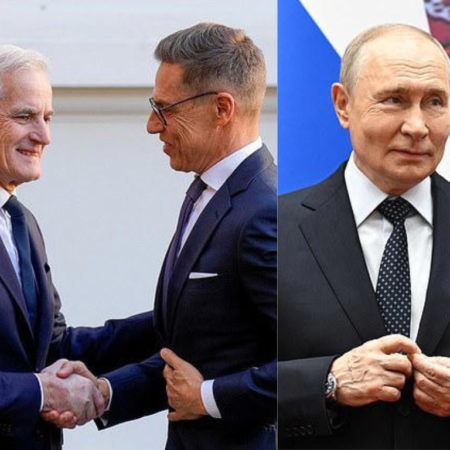
Diplomatic engagement between American officials and Vladimir Putin has added to this uncertainty. Expressions of praise and conciliatory rhetoric towards the Russian president may be part of a negotiating strategy, but they can also create anxiety among allies who view Russia as a direct security threat.
The concern is not that diplomacy itself is undesirable. Negotiations are essential to preventing conflict. The problem arises when allies cannot confidently distinguish between tactical engagement and a fundamental change in strategic priorities.
France’s approach, therefore, can be understood as an attempt to strengthen Europe’s options rather than simply replace the United States. President Emmanuel Macron has continued to operate within the wider transatlantic security framework while arguing that Europe must develop greater strategic autonomy.
That is a more consequential proposition than a simple declaration that Europe no longer needs America. It recognises that the United States remains important while acknowledging that European security cannot rest entirely on assumptions about the future decisions of another country’s leadership.
Britain’s Emergency Warnings: Preparedness Begins at Home
The changing security environment is also influencing how European governments communicate with their citizens. Britain’s emergency-preparedness campaign illustrates that national security is no longer being treated exclusively as a responsibility of the armed forces.
According to The Independent, the UK government’s Be Ready initiative advises households to prepare for disruptions caused by extreme weather, cyberattacks, power cuts and other emergencies. The guidance recommends keeping essential supplies for three days, including drinking water, non-perishable food, cash, torches, batteries, medicines and a means of receiving emergency updates. <Cite refs={[“turn585653view0”]}/>
The significance of this advice lies in its recognition that modern crises can disrupt everyday life without necessarily beginning with a conventional military attack. A cyberattack on critical infrastructure, a prolonged electricity outage or a breakdown in essential services can create serious difficulties for a population even without missiles crossing national borders.
This is an important shift in the understanding of national defence. A country’s resilience depends not only on the weapons it possesses but also on whether its population can withstand temporary disruptions without overwhelming emergency services.
The British approach should not be interpreted as proof that a Russian attack is imminent. Rather, it reflects a government preparing for a wider range of risks in an increasingly uncertain world. Preparedness is most effective when it encourages sensible precautions rather than public panic.
Europe’s Advantage: Acting Before the Crisis
One of the most important lessons from Europe’s evolving security posture is the value of anticipating risks before they become emergencies.
Governments frequently face incentives to prioritise immediate political concerns over threats that may materialise years later. Long-term investments in defence, infrastructure resilience and emergency planning are expensive, and their benefits can be difficult to demonstrate when a crisis never occurs. Yet the absence of a disaster does not necessarily mean that preparation was unnecessary.
European countries have historical reasons to take military threats seriously. The continent has experienced devastating wars, and Russia’s invasion of Ukraine has reinforced concerns about the possibility of territorial aggression returning to the centre of European security planning.
The appropriate response is not to assume that war is inevitable. It is to recognise that deterrence works best when military capability, political resolve and civilian preparedness reinforce one another.
France’s nuclear forces can contribute to the military dimension. Cooperation among European allies can strengthen the political dimension. Britain’s emergency-preparedness campaign addresses the civilian dimension.
These measures serve different purposes, but together they reflect a broader understanding: resilience must be built before the moment when it becomes indispensable.
What India Should Learn From Europe
India’s strategic circumstances differ significantly from Europe’s. It faces a different geography, a different set of security challenges and a distinct relationship with its nuclear-armed neighbours. Its policy choices cannot simply be copied from Paris or London.
Nevertheless, the underlying lesson is relevant: strategic preparedness should be a continuous process rather than a reaction to the latest crisis.
India already possesses nuclear weapons, an established defence-industrial base, substantial military capabilities and experience managing complex security challenges. The priority should be to ensure that these strengths evolve with changing threats.
That means sustained investment in military modernisation, intelligence, cyber defence, critical infrastructure protection and technological capabilities. It also means examining whether existing institutions can identify emerging risks early enough to give policymakers time to respond.
The same principle applies beyond defence. Whether the issue is hostility towards Indian citizens abroad, economic vulnerability, technological dependence or disruptions to essential services, delayed recognition can narrow the range of available responses. Early assessment creates more room for measured, proportionate action.
Civilian preparedness deserves similar attention. Public awareness of emergency supplies, communication failures, cyber disruptions and the importance of reliable information can strengthen national resilience. Such measures should be based on credible risk assessments and practical guidance, not exaggerated predictions of imminent catastrophe.
India also needs to distinguish between strategic autonomy and strategic isolation. Possessing independent military capabilities is essential, but partnerships remain valuable. Europe’s current debate demonstrates why governments seek greater control over their own security decisions while continuing to work with allies.
Deterrence Is About Preventing War, Not Preparing to Fight One Alone
France’s growing role in European security raises a fundamental question about the future of the continent: can European countries maintain credible deterrence while navigating uncertainty over the United States’ long-term commitments?
The answer will depend on whether political declarations translate into practical capabilities, coordinated planning and credible commitments. Nuclear signalling alone cannot resolve Europe’s security dilemma, and expanding deterrence arrangements will require careful management to avoid miscalculation.
Nor should diplomatic engagement with Russia automatically be interpreted as weakness or betrayal. Diplomacy and deterrence can operate together. The objective should be to prevent aggression while preserving channels that can reduce the risk of escalation.
Ultimately, the significance of France’s approach extends beyond the Rafale fighter jet or the prospect of a wider European nuclear umbrella. It reflects a recognition that the international security environment cannot be managed through assumptions that worked in an earlier era.
Britain’s preparedness campaign makes the same point from a different direction. Governments are beginning to ask not only how their militaries would respond to a crisis, but also how their societies would function if essential services were disrupted.
For India, the lesson is equally clear. National strength is not measured solely by defence spending, nuclear capabilities or diplomatic influence. It also depends on the ability to identify vulnerabilities early, invest in resilience and act before circumstances leave policymakers with fewer choices.
The strongest deterrent is not the expectation that a country will win a war after it begins. It is the conviction that the country is prepared enough to make aggression an unattractive choice in the first place.