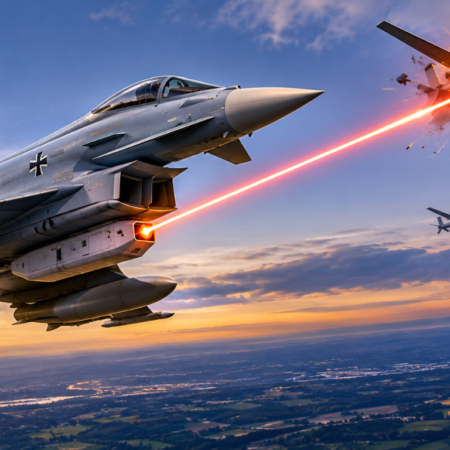
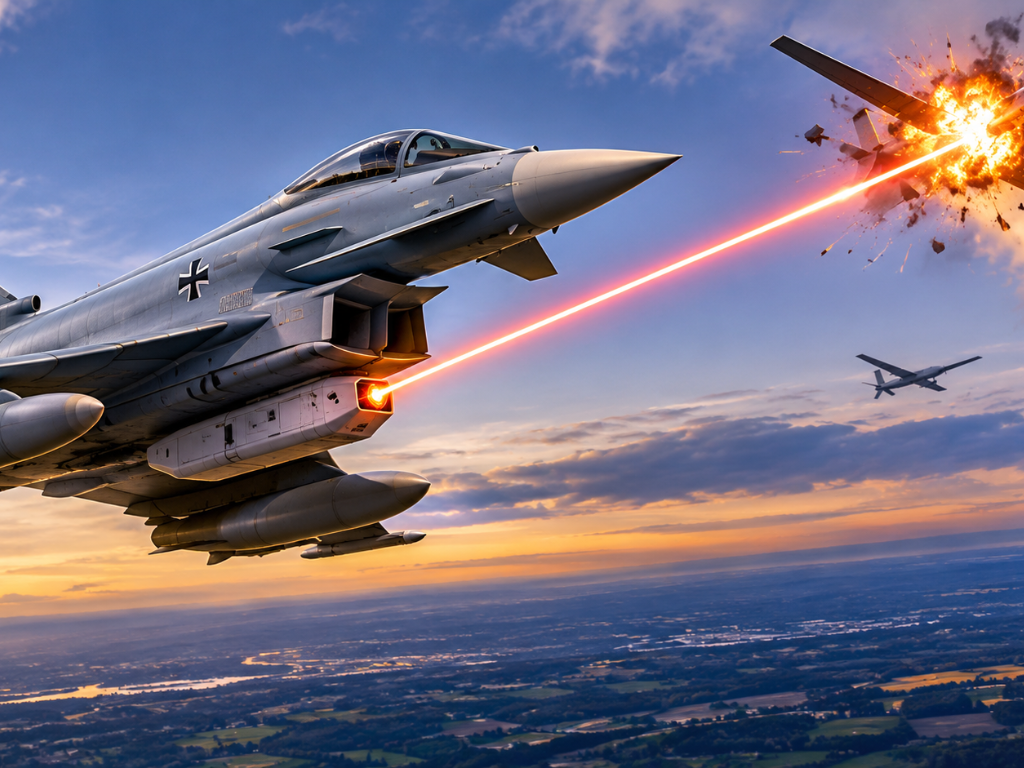
Germany Turns to Laser Weapons for Eurofighter Jets to Counter Drone Swarms and Save Expensive Missiles

Germany has launched a programme to develop airborne laser weapons that could eventually be integrated into its combat aircraft, including the Eurofighter Typhoon, as Berlin looks for cost-effective ways to counter the growing threat posed by inexpensive attack drones and cruise missiles.
The German defence procurement agency has awarded MBDA Deutschland a contract to develop a demonstrator for a pod-based airborne laser weapon. The project aims to establish the technological foundation for deploying high-energy laser systems aboard military aircraft and potentially equipping the German Air Force, known as the Luftwaffe, with a new counter-drone capability.
In a statement issued on November 2, MBDA confirmed that it had received an order from the Federal Office of Bundeswehr Equipment, Information Technology and In-Service Support (BAAINBw) to develop the demonstrator.
The company said the programme would focus on testing the feasibility of an airborne laser weapon, with essential components of the proposed laser pod being designed for future flight operations.
Although MBDA has not disclosed the contract value, development timeline or laser power specifications, the programme signals Germany’s growing interest in directed-energy weapons as modern warfare increasingly features large numbers of relatively inexpensive unmanned aerial vehicles (UAVs).
Eurofighter Typhoon Could Become a Potential Platform
Germany operates a substantial fleet of Eurofighter Typhoon multirole combat aircraft and is also acquiring F-35A stealth fighters from the United States. Both platforms could potentially benefit from future developments in airborne directed-energy weapons, although MBDA has not identified the aircraft intended for the demonstrator.
An illustration accompanying the company’s announcement shows large fighter-like unmanned aircraft carrying laser pods beneath their fuselages. However, this does not establish which aircraft will eventually receive the operational system.
MBDA described airborne laser development as the ‘supreme discipline’ of laser weapon technology because of the demanding requirements involving weight, dimensions, power generation and resistance to the stresses associated with flight.
The long-term objective is to develop an airborne laser capability capable of countering drones and cruise missiles.
The programme also reflects Germany’s effort to strengthen domestic defence technology and reduce dependence on foreign suppliers. Berlin has treated laser technology as a strategic research and development priority since 2019, while MBDA has invested in developing laser effectors and demonstrators for different military applications.
Why Germany Wants Laser Weapons to Counter Drones
The growing use of inexpensive one-way attack drones in Ukraine and the Middle East has exposed a major problem for conventional air defence systems: the cost of intercepting incoming threats can be significantly higher than the cost of launching them.
Military forces frequently rely on expensive air-to-air missiles and surface-to-air interceptors to destroy relatively cheap drones. This creates an economic imbalance, particularly when defending against coordinated attacks involving dozens or hundreds of unmanned aircraft.
Germany’s proposed airborne laser system could help address this problem.
Unlike conventional missiles, high-energy laser weapons use concentrated beams of light to heat, damage or destroy a target. Once operational, they could offer aircraft a reusable engagement capability against certain classes of drones without requiring pilots to expend expensive missiles for every interception.
Air-to-air missiles such as the Meteor and AIM-120 AMRAAM can cost hundreds of thousands of euros or more than a million euros, depending on the variant and procurement arrangements.
By comparison, the marginal cost of a laser engagement can be substantially lower, primarily involving electricity and associated system operating costs.
Laser weapons also offer effectively deep ammunition capacity, provided the aircraft has sufficient electrical power and cooling capacity. Their operational limitations are therefore linked to energy generation, thermal management and the time required to maintain the beam on a target rather than the number of physical missiles carried.
Another advantage is engagement speed. Since laser energy travels at the speed of light, the weapon does not require the flight time associated with conventional missiles or rockets.
This could make airborne lasers particularly useful against certain fast-approaching threats, although their effectiveness will depend on detection, tracking, engagement distance and atmospheric conditions.
Airborne Laser Weapons Face Major Technical Challenges
Despite their potential advantages, integrating high-energy laser weapons into fighter aircraft is considerably more complicated than deploying them on ships or ground-based platforms.
A powerful laser requires substantial electrical energy and generates considerable waste heat. Naval vessels and fixed installations can accommodate relatively large generators, energy-storage systems and cooling equipment. Fighter aircraft, however, have strict restrictions on available power, payload capacity and internal space.
Engineers must therefore develop a compact system that integrates the laser source, power-conditioning equipment, energy storage, cooling mechanisms, beam director and precision tracking systems into an aircraft-compatible pod or internal bay.
Atmospheric conditions create another challenge. Dust, moisture and turbulence can absorb, scatter or distort laser energy, reducing the amount of power that reaches the target.
The system must also maintain precise tracking and keep the laser beam focused on a particular area long enough to damage or disable the target. The required engagement time can vary depending on the target’s size, distance, material and vulnerability.
These challenges mean that Germany’s programme is still at the technology-demonstration stage rather than representing an operational weapon ready for deployment.
US and China Have Also Explored Airborne Laser Weapons
Germany is not the first country to investigate integrating high-energy laser weapons into military aircraft.
The United States previously pursued the Self-Protect High Energy Laser Demonstrator (SHiELD) programme, which aimed to develop a pod-mounted directed-energy weapon capable of protecting aircraft against incoming surface-to-air and air-to-air missiles.
Washington also worked on the Airborne High Energy Laser (AHEL) programme for potential deployment aboard the AC-130J gunship.
However, these initiatives did not result in an operational airborne laser capability being fielded by the US Air Force.
China, meanwhile, has also been linked to efforts to develop airborne laser weapons. Chinese media reports previously suggested that the country’s J-20 stealth fighter could eventually receive such capabilities, although no operational integration has been publicly confirmed.
The challenges associated with power generation, cooling, weight and beam control continue to make airborne laser weapons one of the most demanding areas of military technology.
A New Layer in Germany’s Air Defence Strategy
If successfully developed, Germany’s airborne laser weapon could provide the Luftwaffe with another option for dealing with increasingly sophisticated aerial threats.
Rather than using expensive air-to-air missiles against every incoming drone, pilots could potentially employ laser weapons against suitable targets while reserving conventional interceptors for advanced missiles, enemy aircraft and other high-value threats.
The technology could also complement existing counter-drone systems, including electronic warfare, ground-based air defence and naval laser weapons.
For Germany, the objective is not necessarily to replace conventional missiles but to create a more economical and sustainable approach to defending against mass drone attacks.
As conflicts in Ukraine and the Middle East demonstrate the growing importance of inexpensive unmanned systems, the ability to neutralise large numbers of aerial threats without exhausting expensive missile inventories could become a significant military advantage.
However, whether Germany can overcome the engineering challenges and turn its proposed laser demonstrator into an operational airborne weapon remains to be seen.