Europe’s economic anxieties and political divisions are creating opportunities for a new kind of geopolitical contest. While inflation, immigration, housing costs and pressure on public services can explain public anger, the suggestions that unrest across European countries is part of a coordinated American strategy requires careful examination. The bigger story lies in how domestic crises are increasingly being weaponised in the global battle for political influence.
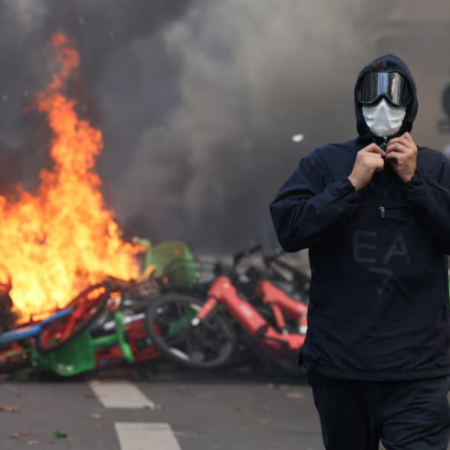
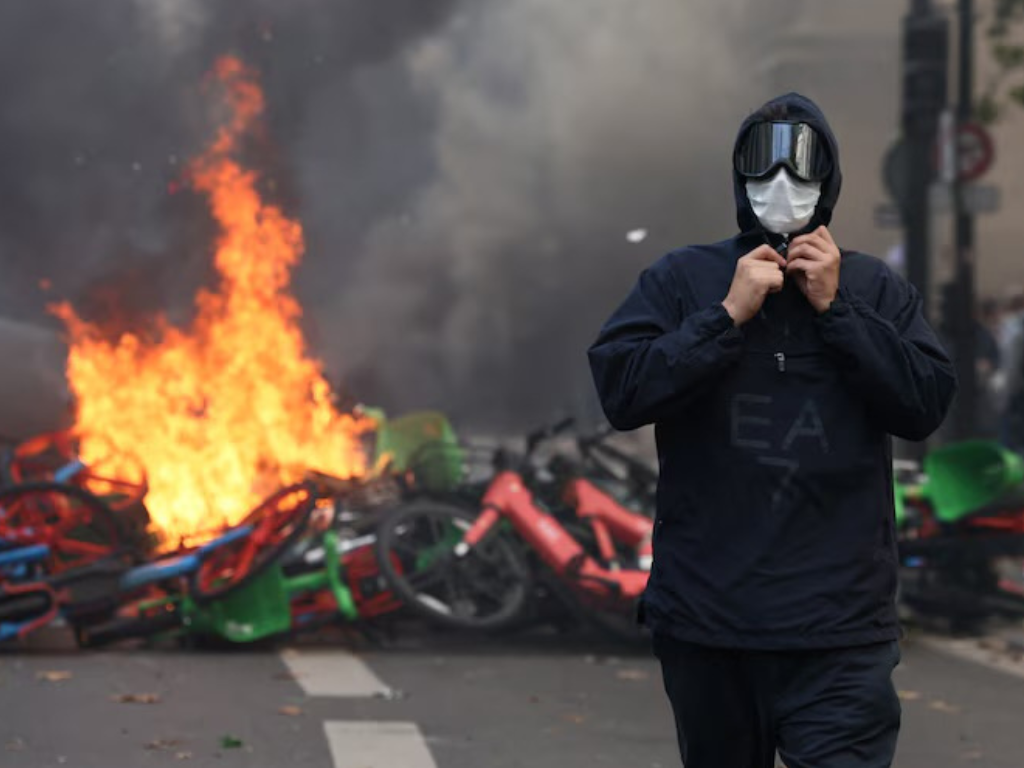
The images are disturbing. Burning buildings, confrontations with police, damaged storefronts and masked individuals breaking into luxury retail outlets are hardly the picture of stability that European capitals have spent decades cultivating. Paris, Milan and other major cities have long symbolised prosperity, cultural sophistication and the promise of the European social model. When such images dominate social media, they do more than document disorder. They challenge the credibility of the political systems behind them.
But the real question is not simply why people are taking to the streets. It is who benefits politically when Europe appears to be losing control of its own streets.
Beyond Protests: Europe’s Crisis of Confidence
Public protests are not inherently evidence of institutional failure. In democratic societies, demonstrations are a legitimate way to demand accountability. Rising living costs, inadequate housing, pressure on education systems, public spending cuts and dissatisfaction with political leadership can all produce genuine public anger.
However, peaceful demonstrations and organised criminal violence are two different things. A student demanding better educational facilities cannot automatically be equated with an individual looting a luxury showroom or setting fire to a public building. Treating all protesters as rioters undermines legitimate grievances, while presenting every act of vandalism as political resistance risks normalising criminal behaviour.
The distinction matters because political instability often grows when governments fail to separate legitimate public demands from violence and opportunistic criminality.
Europe’s challenge is that several long-running problems are converging. Housing affordability has become a serious concern in many urban centres. Younger generations face uncertainty over employment, purchasing homes and maintaining the standard of living enjoyed by earlier generations. Governments must balance social spending, defence commitments, energy security and debt management.
These pressures create fertile ground for political mobilisation. They also create opportunities for actors who want to redirect public anger towards a particular community, ideology or foreign adversary.
The first mistake, therefore, would be to assume that every demonstration has the same cause. The second would be to dismiss the possibility that political organisations, online networks or opportunistic actors can exploit an existing crisis. Europe needs to investigate both possibilities without confusing suspicion with evidence.
Trump’s Immigration Politics: Turning Europe into a Warning for America
Donald Trump’s political strategy has consistently placed immigration, border enforcement and national identity at the centre of American politics. His argument is straightforward: uncontrolled immigration, according to his political messaging, places pressure on public services, threatens national security and weakens social cohesion.
Whether voters accept this argument depends on their experiences, economic circumstances and political preferences. But its electoral significance is undeniable.
Images of disorder in European cities can serve as powerful political material for American conservatives. They provide a visual contrast between the promise of strict border enforcement and the perceived consequences of more permissive immigration policies.
This is where Europe’s domestic difficulties acquire a wider geopolitical dimension.
A video of a burning building in Paris can circulate far beyond France within hours. On American social media, the same footage can become an argument for stricter border controls. Political commentators can use it to question multiculturalism, while election campaigns can present it as evidence that existing immigration policies have failed.
The transformation is remarkable: an incident rooted in a particular city, with its own local circumstances, becomes a symbol in an entirely different country’s political debate.
Trump and his allies do not need to cause European unrest to benefit from it politically. They need only interpret it in a way that reinforces their existing message. That distinction is crucial.
There is a substantial difference between claiming that the American political establishment benefits from European instability and alleging that Washington deliberately engineered the unrest. The former can be examined through political messaging, electoral incentives and public statements. The latter requires credible evidence of coordination, financing or operational involvement. Without such evidence, the claim of an American-directed destabilisation campaign remains speculation.
Nevertheless, the political exploitation of a crisis can be just as consequential as its original cause. A government can turn another country’s failure into a domestic electoral argument without having played any role in producing that failure.
Europe may consequently find itself fighting two battles: one against the problems within its own borders and another over the international narrative surrounding those problems.
The Energy Crisis: How Geopolitical Decisions Reach European Households
Immigration is politically powerful, but it cannot explain every economic difficulty facing Europe. The energy question deserves equal attention.
Europe’s economic model has been challenged by the consequences of Russia’s war against Ukraine, the disruption of established energy relationships and the cost of replacing some Russian supplies with alternative sources. The destruction of the Nord Stream pipelines in 2022 further complicated Europe’s energy security. The continent has had to adapt its energy infrastructure, diversify suppliers and manage the financial consequences of a major geopolitical rupture.
The broader lesson is that energy dependence is never merely an economic issue. It is also a question of strategic autonomy.
For decades, access to relatively affordable Russian pipeline gas supported important sections of European industry. Following Russia’s full-scale invasion of Ukraine, European governments faced a difficult choice: continue established energy relationships despite the security consequences, or accept the costs and risks of restructuring supply.
Europe largely chose the latter. It diversified supplies, expanded LNG imports, accelerated renewable energy development and introduced measures to reduce dependence on Russian fossil fuels. These decisions were not cost-free, and their economic effects have varied across countries and sectors.
The United States became an important supplier of LNG to Europe. American energy companies benefited from increased demand, although European purchases also came from other suppliers, and prices were influenced by global market conditions.
This creates an uncomfortable strategic question for Europe: can a continent claim genuine strategic autonomy if its energy security, military deterrence and economic resilience remain heavily influenced by external powers?
The answer is not to abandon alliances or ignore Russian aggression. It is to recognise that dependence creates vulnerabilities, even when the supplier is an ally.
The same principle applies to the Middle East. Any escalation threatening the Strait of Hormuz, a critical route for global oil and LNG shipments, can affect energy prices, shipping costs, inflation and industrial production far beyond the conflict zone. The extent of the impact depends on the duration of the disruption, alternative supply routes, inventories and market responses.
When energy costs rise, households pay more for transport and heating, businesses face higher operating expenses, and governments come under pressure to provide relief. Public spending then becomes more difficult to manage.
It is therefore reasonable to examine how American foreign policy, European security commitments and global energy markets interact. It is not reasonable, however, to attribute every European price increase or protest directly to Washington without examining domestic taxation, regulation, fiscal policy, market structures and other causes.
The geopolitical argument is strongest when it identifies concrete mechanisms rather than searching for a single villain.
The American Political Incentive: A Crisis Abroad, an Advantage at Home
American politics has entered a period in which foreign developments increasingly serve as domestic campaign material.
Immigration is one of the clearest examples. When European governments struggle to manage border pressures, integrate newcomers or respond to public anxiety, American politicians who favour stricter immigration controls can present those difficulties as warnings to their own voters.
This does not mean European governments are merely instruments of American politics. European voters have their own concerns, political traditions and national interests. Nor does it mean every American conservative opposes immigration in all circumstances. The debate is more complex than a simple division between open borders and closed borders.
Nevertheless, the political incentive is clear: if voters believe that permissive immigration policies have contributed to insecurity or declining living standards elsewhere, they may become more receptive to restrictive policies at home.
The same dynamic operates in reverse. Images of aggressive deportations, family separations or excessive enforcement can be used by political opponents to argue that restrictive policies violate human rights or damage America’s international reputation. In both cases, imagery becomes political ammunition.
The question is whether voters receive the context necessary to judge the evidence. A viral clip of a robbery cannot establish the nationality or immigration status of the perpetrators. A crime committed by an undocumented migrant does not establish that migrants as a whole are dangerous. Equally, dismissing every public concern about immigration as prejudice prevents governments from addressing genuine problems.
The political danger emerges when individual incidents replace evidence-based policymaking.
For Europe, the challenge is to prevent domestic failures from becoming a permanent source of polarisation. For America, the challenge is to ensure that European instability is not used as a substitute for an honest assessment of America’s own economic and social problems.
Is Europe Facing an Arab Spring Moment?
The comparison with the Arab Spring is compelling as a dramatic headline, but it should be treated cautiously.
The Arab Spring was not a single, centrally directed movement with one uniform objective. Beginning in Tunisia in late 2010, popular uprisings spread across parts of the Arab world amid a combination of authoritarian rule, corruption, unemployment, economic grievances and demands for political dignity. Their outcomes differed dramatically, from political transitions to civil conflict and renewed authoritarianism.
European democracies operate under different institutional conditions. They generally have competitive elections, established opposition parties, independent civil society organisations and legal mechanisms through which governments can be challenged.
These institutions do not make instability impossible. They provide mechanisms for managing conflict without necessarily dismantling the political system.
A genuine comparison would therefore ask whether demonstrations are developing into sustained nationwide movements, whether opposition organisations are mobilising around common demands, whether institutions are losing public legitimacy and whether governments are responding effectively.
Simultaneous protests alone do not establish the existence of a coordinated international campaign.
Social media can make unrest appear more synchronised than it actually is. Similar economic pressures may produce demonstrations in several countries at roughly the same time. Activists can imitate tactics across borders, while online algorithms amplify dramatic footage regardless of its date, location or political context.
Foreign influence operations are also possible in such an environment. Governments, political movements and non-state actors can amplify divisive content, circulate misleading narratives or exploit existing grievances. But demonstrating that such activity exists is different from proving that it initiated a particular protest movement.
Europe must investigate credible evidence of foreign interference while avoiding the temptation to blame outsiders for every domestic failure.
The more immediate danger may be less spectacular than an Arab Spring-style revolution: a prolonged erosion of trust in democratic institutions, growing hostility between communities and the normalisation of political extremism.
That process can weaken a democracy even when its institutions remain formally intact.
India’s Lesson: Strategic Autonomy Matters More Than Political Slogans
For India, the European experience offers a lesson in economic resilience and foreign-policy independence.
India imports a substantial share of its crude oil requirements and remains exposed to fluctuations in international energy prices. Its large population, development needs and infrastructure requirements make affordable energy essential to economic growth.
New Delhi’s decision to maintain and adjust energy purchases according to national interests, including buying Russian crude after the invasion of Ukraine, demonstrated the importance of preserving policy flexibility. Such decisions have also involved diplomatic trade-offs, external pressure and changing commercial calculations.
Strategic autonomy does not mean ignoring international law, abandoning partnerships or treating every foreign-policy dispute as an opportunity for confrontation. It means retaining sufficient freedom to make decisions based on national priorities rather than automatically following another power’s preferences.
India’s economic performance also needs to be assessed through more than a headline growth figure. Strong GDP growth can coexist with employment challenges, uneven household incomes, regional disparities and pressure on essential services. Similarly, comparisons between Indian and European inflation rates must account for differences in consumer baskets, energy subsidies, taxation and statistical methods.
The real achievement to pursue is sustained growth alongside stable prices, productive employment, affordable energy and stronger public services.
India should also resist the temptation to interpret European difficulties as proof that its own political or economic model is automatically superior. Democracies can learn from one another’s successes and failures. European social protections, research institutions and industrial capabilities remain significant strengths, just as India’s scale, services sector and economic dynamism offer important advantages. The strategic lesson is to build resilience before a crisis arrives.
That means diversifying energy suppliers, strengthening domestic manufacturing, investing in renewable and conventional energy security, expanding skills and employment opportunities, maintaining fiscal discipline and ensuring that economic growth reaches ordinary households.
It also means protecting social cohesion. When citizens believe that opportunities are shrinking and institutions are indifferent to their difficulties, political entrepreneurs gain an opening to redirect frustration towards outsiders or rival communities. No country is immune to this risk.
The Real Battle Is Over Who Controls the Narrative
Europe’s unrest, wherever it occurs and whatever its precise causes, should be examined on its own evidence. The existence of demonstrations in several countries does not establish a single coordinated movement, and allegations about specific events, casualty figures, arrests or political resignations require independent confirmation.
Yet the wider political dynamic deserves serious attention.
In today’s interconnected information environment, a domestic crisis can rapidly become an international political instrument. An economic problem becomes a debate over immigration. An incident of criminal violence becomes a referendum on national identity. An energy shock becomes an argument over foreign-policy alignment. A street protest becomes a campaign message thousands of kilometres away.
The actors who benefit most from this process are often those who can turn complexity into a simple story with a clear enemy.
For Trump’s political movement, European disorder can reinforce the argument that border restrictions are necessary. For European populists, the same disorder can strengthen demands for changes to immigration and public spending. For foreign adversaries, visible divisions among Western democracies may offer opportunities to undermine confidence in their institutions. None of these incentives, by itself, proves that any actor orchestrated the unrest.
That is the distinction serious geopolitical analysis must preserve: benefiting from a crisis is not the same as causing it.
Europe’s governments should address the material grievances that make public anger possible, enforce the law consistently, distinguish peaceful protest from criminality and investigate credible evidence of organised interference. They must also recognise that public trust cannot be restored through policing alone. Affordable housing, reliable public services, employment opportunities and accountable leadership matter just as much.
America, meanwhile, must confront its own political divisions rather than treating every European difficulty as evidence that its domestic problems have already been solved.
And India should draw a practical conclusion: national strength depends not merely on economic growth or diplomatic influence, but on the capacity to withstand external shocks without sacrificing domestic stability or independent decision-making.
The future of Europe will not be determined by viral videos alone. It will depend on whether its political institutions can convert public anger into reform before that anger is captured by extremism, polarisation or foreign political agendas.
The central question is therefore not simply who is setting Europe’s streets on fire. It is who gains power when the public begins to believe that the system itself is burning.