
The Makkah Joint Defence Agreement (MJDA) — a trilateral defence pact between Saudi Arabia, Türkiye and Pakistan signed on 7 August 2026 — faced its first real security test in September 2026 as Houthi attacks on Saudi Arabia intensified.
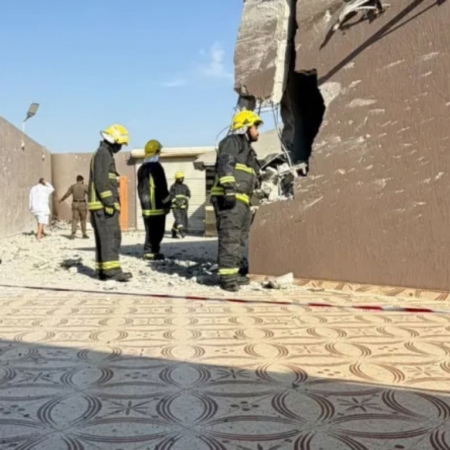
On 16 September 2026, Saudi Arabia said its air defences had intercepted and destroyed a Houthi drone south of Makkah before it could enter the holy city’s restricted airspace. The Houthis denied targeting Makkah. The episode drew strong condemnation from Pakistan and Türkiye and revived a question that has followed the pact since its signing: how — and whether — a month-old collective-defence commitment translates into action on the ground.
What is the Makkah Joint Defence Agreement?
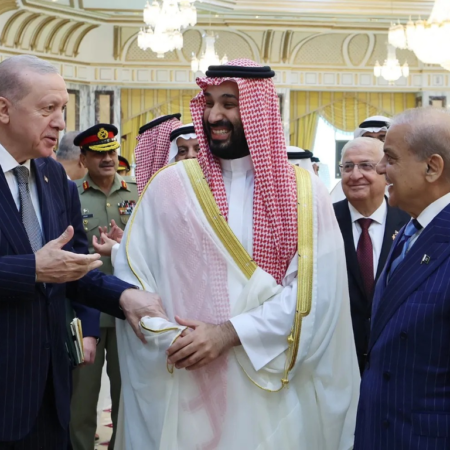
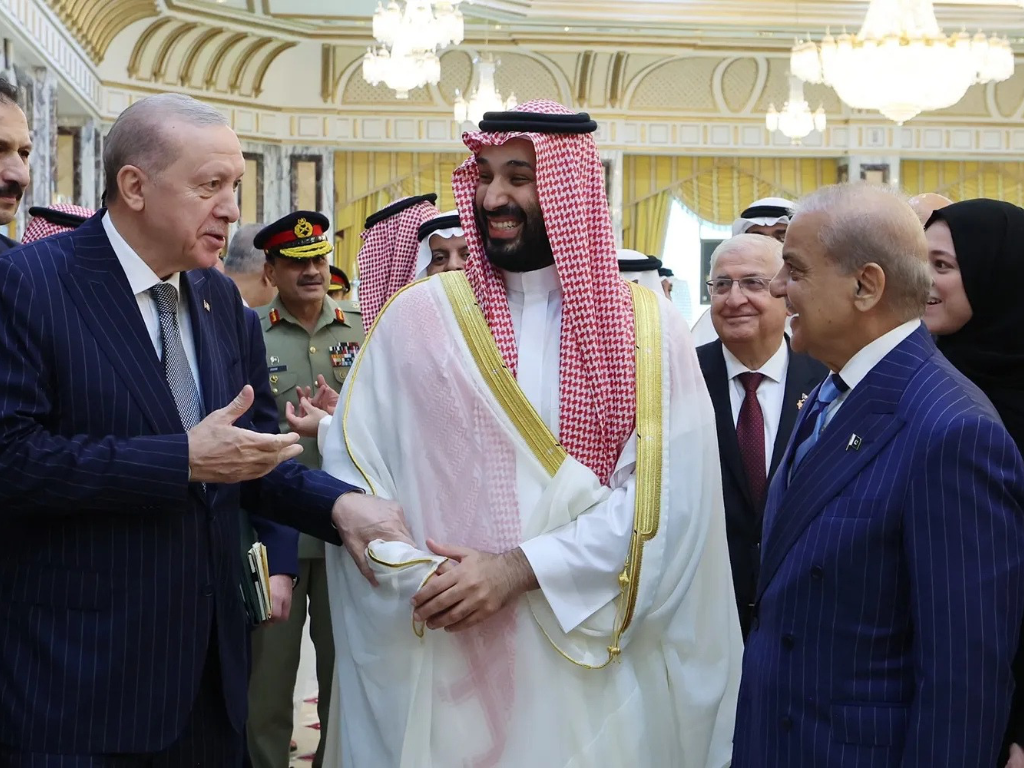
The MJDA was signed at Al-Safa Palace in Makkah on 7 August 2026 by Saudi Crown Prince and Prime Minister Mohammed bin Salman, Turkish President Recep Tayyip Erdoğan, and Pakistani Prime Minister Shehbaz Sharif, at the conclusion of the Makkah Al-Mukarramah Summit for Joint Defence.
It did not emerge in isolation. Saudi Arabia and Pakistan already had a bilateral Strategic Mutual Defence Agreement, signed in September 2025 at Riyadh’s Al-Yamamah Palace. The Makkah pact effectively widens that bilateral commitment into a trilateral one by bringing Türkiye into the framework.
At its core is a single, central commitment: an armed attack on any one of the three states is to be treated as an attack on all three. Pakistan has linked this to the right of individual and collective self-defence recognised under Article 51 of the UN Charter. All three governments describe the pact as defensive in character, built around collective deterrence and regional stability rather than aimed at any specific country — Turkish officials have said the arrangement does not identify any state as a common threat.
Major Features of the Pact
Combined, the three countries form a sizeable bloc. According to the 2026 Global Firepower Index, they together field close to 1.4 million active-duty personnel — Pakistan contributes the largest share (about 660,000), followed by Türkiye (about 481,000) and Saudi Arabia (about 247,000) — alongside roughly 3,400 aircraft, 6,000 tanks and more than 340 naval assets between them.
The First Major Test: Houthi Attacks on Saudi Arabia
The pact’s practical relevance became evident as Houthi attacks on Saudi territory intensified through September 2026. On 8–9 September, Houthi missiles and drones struck Saudi cities and energy-linked infrastructure — including Abha, Khamis Mushait, Jazan and Najran — injuring more than 70 people. The Houthis are also reported to have taken control of the Red Sea port of Mocha, raising concerns about their ability to pressure shipping through the Bab-el-Mandeb strait.
The crisis sharpened further when Saudi Arabia reported intercepting a Houthi drone south of Makkah on 15–16 September, before it could enter the holy city’s restricted airspace. Saudi authorities treated the protection of Makkah as a paramount security concern; the Houthis denied targeting the city.

Pakistan’s Response
Pakistan’s response illustrates the gap between political commitment and operational action that runs through this whole episode.
On 9 September, as Houthi attacks on Saudi Arabia intensified, Defence Minister Khawaja Asif told a Pakistani television channel that unprovoked aggression, or any spillover of the Yemen conflict into Saudi Arabia, would make the Makkah pact operational, and that Pakistan was bound to honour its terms.
Within a day or two, Pakistan’s Foreign Office moved to temper this. At a briefing on 10 September, spokesperson Sajjad Haider Khan said no military response was then under discussion, described the MJDA as an “umbrella agreement” under which further implementing mechanisms would still need to be worked out, and stressed that the pact was purely defensive in purpose.
After the reported Makkah drone incident, Pakistan’s Deputy Prime Minister and Foreign Minister Ishaq Dar strongly condemned the attack and reaffirmed Pakistan’s support for Saudi Arabia in protecting the Two Holy Mosques and the safety of pilgrims and residents. Defence Minister Asif subsequently said Islamabad would stand with Saudi Arabia practically and diplomatically if the situation escalated — even as Pakistan continued to urge restraint and diplomatic engagement, reflecting its need to balance ties with both Saudi Arabia and Iran.
On the Türkiye’s side On 16 September, Türkiye’s Foreign Ministry condemned the reported drone attack attributed to the Houthis and reaffirmed support for Saudi Arabia’s sovereignty, territorial integrity and security. Ankara called for an end to the attacks and cautioned against steps that could widen regional tensions. Türkiye’sresponse has, so far, remained diplomatic — no joint military action under the Makkah pact has been publicly announced.
The “Makkah Test”: Collective Defence vs Automatic Military Action
At the political level, the pact’s language is unambiguous: an attack on one member is to be treated as an attack on all. But the publicly available details stop well short of an automatic military-intervention mechanism. Turkish Foreign Minister Hakan Fidan has indicated that, in practice, a member under attack would need to request assistance and specify what kind of support it needs — rather than the pact triggering an automatic joint response.
This is worth underlining, because it is also, in fact, how NATO’s Article 5 works: it does not commit allies to a uniform or automatic military response either. Each ally decides for itself what action it deems necessary, which may or may not include the use of force — a nuance often missed when “Article 5-style” pacts are treated as guarantees of automatic war-fighting. The September episode captures this precisely: political solidarity, consultation and diplomatic support have so far preceded — and may in some circumstances substitute for — military deployment, with the actual activation procedures still not public.
Why the Houthi Crisis Matters
The Houthi conflict gives the pact an immediate, concrete connection to Yemen, Red Sea security and the Bab-el-Mandeb corridor — a chokepoint that carries a large share of global container traffic and energy shipments. Houthi pressure on Saudi energy infrastructure, combined with reported control of Mocha port, raises the stakes for regional and international shipping alike.


Makkah Pact vs NATO Article 5
|
Feature |
Makkah Agreement (2026) |
NATO Article 5 (1949) |
|
Membership |
Three members; Bangladesh has signalled openness to joining |
32 member states |
|
Institutional depth |
Early-stage; Secretariat set up in Riyadh, Aug 2026 |
Decades of integrated alliance structures |
|
Military command |
No publicly disclosed integrated command |
Established, integrated NATO command structure |
|
Force commitment |
No publicly disclosed predetermined contributions |
Each ally decides its own response — not an automatic joint force |
|
Track record |
Untested beyond the September 2026 Houthi episode |
Invoked only once, after the 11 September 2001 attacks |
The contrast should not be overstated on the “automatic response” front — NATO’s own Article 5 does not oblige an automatic military response either; it obliges consultation and “such action as it deems necessary,” which can include but does not require force. The sharper differences lie elsewhere: in institutional depth, integrated command, and decades of standing procedure that the Makkah framework has not yet built.
Strategic Significance
Significance and Implications for India
India’s official response has been measured: the Ministry of External Affairs has said it is closely following developments bearing on India’s security and will act to safeguard its national interests — language consistent with India’s practice of not commenting sharply on pacts to which it is not a party.
Even so, the pact has drawn attention in India’s strategic community for several reasons:
At the same time, the pact is not inherently anti-India — none of the three signatories has framed it that way. India retains a substantial, independent relationship with Saudi Arabia through the India–Saudi Strategic Partnership Council (established 2019), alongside strong ties with the UAE and other Gulf states, and frameworks such as I2U2 and the India–Middle East–Europe Economic Corridor (IMEC) give India its own institutional footholds in the region.
For India, the broader lesson is one of strategic balancing rather than alarm: deepening Gulf partnerships bilaterally, strengthening Indian Ocean Region maritime capability, keeping alternative connectivity such as Chabahar port open as a hedge, and avoiding being pulled into rigid bloc politics in a West Asia that is itself turning more multipolar.
Key Challenges
The pact faces several challenges. There are divergent strategic interests among the three members, as they do not share identical threat perceptions. The Yemen dilemma presents another concern, since direct military involvement could potentially draw the members into a conflict that none may be willing to fight alone. The Iran factor also requires careful balancing, particularly for Pakistan and Türkiye, both of which maintain working relationships with Tehran. Furthermore, the pact currently lacks publicly defined procedures for activation, command structures, and force contributions, creating uncertainty about how collective defence would operate in practice. Its future composition is also unsettled, with Bangladesh signalling openness to joining, while Saudi Arabia is reportedly cautious about Egyptian membership. Finally, any military escalation involving the pact could potentially widen regional conflicts rather than contain them, increasing the risks associated with its implementation.
The Makkah Joint Defence Agreement represents an attempt to build a new layer of regional collective security linking Saudi Arabia, Türkiye and Pakistan — one that, within weeks of being signed, was formally institutionalisedas the Makkah Defence Alliance. Its long-term significance will depend less on the declaration itself and more on whether the three countries build effective institutions, intelligence-sharing mechanisms, defence-industrial cooperation and coordinated crisis-response procedures — and on whether other states, from Bangladesh to Egypt, eventually join.
The September 2026 Houthi escalation has provided an early and sensitive test. Saudi Arabia’s reported interception of a drone south of Makkah, followed by strong condemnation from Pakistan and Türkiye, has demonstrated political solidarity — but no publicly announced joint combat operation has followed, and Pakistan’s own brief signal toward activation, quickly tempered by its Foreign Office, shows how far the pact still is from an automatic trigger. Its future will depend on whether its members move from declaratory collective defence toward clearly defined operational cooperation, while containing the risk of wider regional escalation.
For India, the more durable takeaway may lie less in this pact specifically than in the broader shift it reflects: a West Asia recalculating its security guarantees, in which New Delhi’s own web of bilateral and minilateral partnerships will matter more, not less.

Why “Make in India” iPhone so Expensive than U.S. and UAE ?