Pakistan’s emergency gamble: Force can suppress a march, not settle a federation

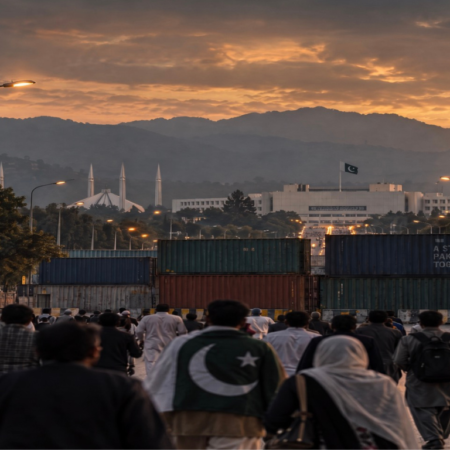
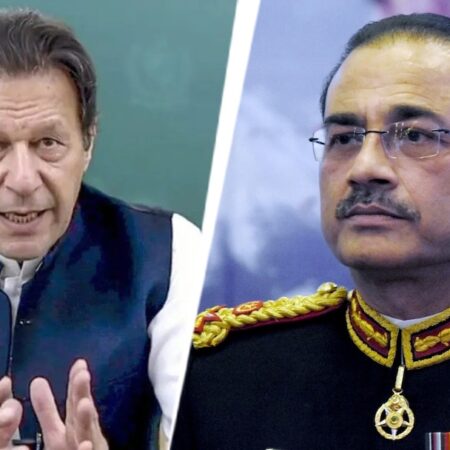
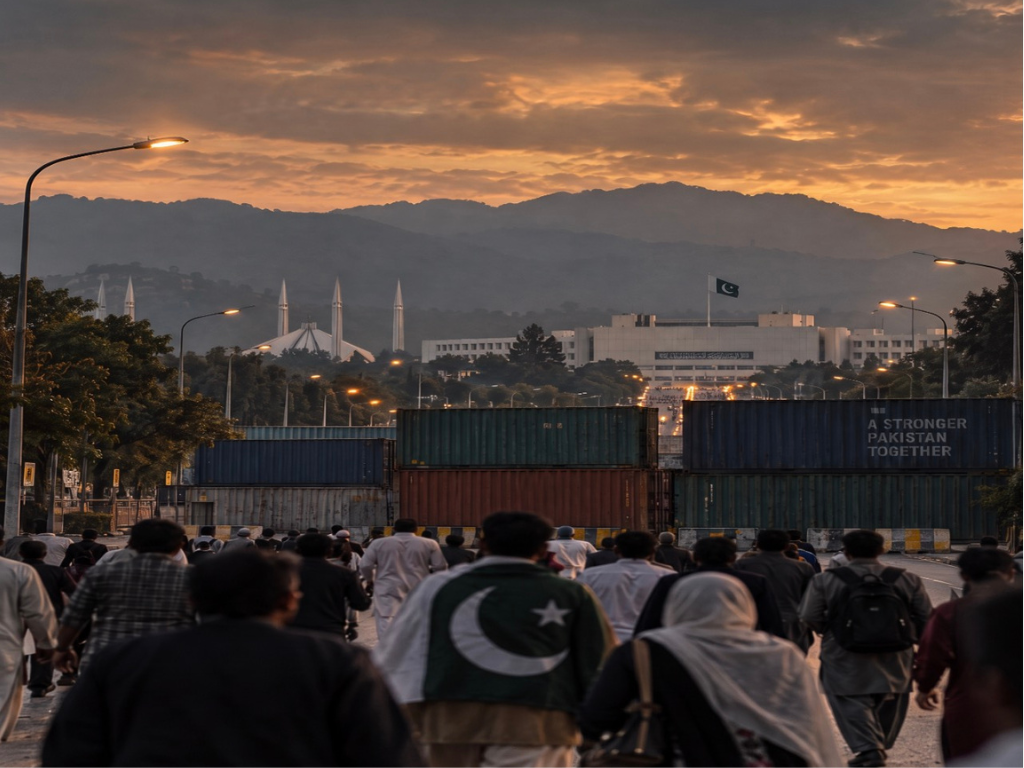
Pakistan’s latest political crisis arrived with the visual grammar of a siege: shipping containers stacked across Islamabad’s roads, a protest caravan moving through Khyber Pakhtunkhwa (KP), and a presidential proclamation placing the province under emergency and governor’s rule. The march, led by Chief Minister Sohail Afridi and backed by Imran Khan’s Pakistan Tehreek-e-Insaf (PTI), was intended to demand the jailed former prime minister’s release. On 11 October, President Asif Ali Zardari approved the federal cabinet’s recommendation to impose emergency measures and displace the provincial administration.
That sequence matters. Pakistan’s authorities say the province faces escalating Islamist militancy and that its PTI government has failed to cooperate on counterterrorism.. The proclamation cites attacks of “unprecedented level of violent intensity,” and ministers have accused the PTI government of being “hand in glove with the terrorists.” The think-tank PICSS counts 1,232 militant attacks nationwide in the first nine months of 2026, already above its 2025 full-year tally of 1,066. The threat is real. But officials have offered no public evidence for the charge of collusion. The army’s media wing said in July that it had conducted some 4,000 counter-terrorism operations in six months across KP and Balochistan, roughly 200 a day, by this arithmetic. An army that active, cannot credibly claim that one provincial government is the obstacle.
PTI rejects the charge, arguing that the federal centre has withheld the resources needed to address the threat and that the emergency is designed to stop its protest. The two explanations are not mutually exclusive: KP can be confronting a grave security problem while the federal government also calculates that extraordinary powers will weaken its political opponent. The timing makes the second possibility impossible to dismiss.
The timing is the second problem. The terrorism argument gathered force only after PTI’s long march was announced. The march left Lakki Marwat on 4 October with Afridi at its head, after being postponed from 27 September and after two rounds of talks with the government failed, according to NPR. Its demands were simple: Khan’s release, hospital treatment, and family access. Khan has been in jail since 2023. The government’s answer was containers across Islamabad’s approaches, police drawn from across the country, and, finally, the removal of the government that had organised the march. For PTI and for many neutral observers, the sequence tells its own story.
The larger pattern is hard to miss. The 27th Amendment of November 2025 made Munir a Field Marshal for life, created the post of Chief of Defence Forces for him, and gave him immunity from prosecution. Munir was removed as director-general of the Inter-Services Intelligence after only about eight months, during Khan’s tenure as prime minister. That is an interpretation, not an established fact. But it is widely shared in Pakistani political circles, and it shows how personalised the contest has become.
The distinction between emergency and martial law is important. The federal action invokes constitutional provisions—Articles 232 and 234—not an announced military takeover. Article 232 concerns an emergency; Article 234 allows the centre to assume provincial functions when it says constitutional governance has broken down. Under the latter, the governor can exercise provincial executive authority and the provincial assembly’s powers may be shifted to Parliament. The measures are subject to constitutional procedures and time limits, though the emergency framework creates a wider and potentially longer-lived intervention.
Calling the move “martial law” may capture the public perception of military dominance, but it is not legally precise. That precision does not make the consequences trivial. Amnesty International has raised concerns about reports of detentions of political figures, including the chief minister, internet disruptions and the deployment of armed forces. It warns that emergency powers cannot become a licence to silence dissent or concentrate power without independent oversight.Those are not arguments against counterterrorism. They are the conditions under which counterterrorism retains public legitimacy.
The most consequential question is whether emergency rule addresses militancy or simply relocates authority. If the federal centre’s case is that the provincial government cannot control violence, it must show how taking over the province will improve intelligence, policing, civilian protection and coordination. If the underlying problem includes mistrust between local communities and the state, replacing elected provincial authority may deepen the very alienation that militants exploit. Security operations can disrupt armed groups; they cannot by themselves repair a broken political compact.
The Pashtun Question

KP’s political identity also makes the stakes unusually high. Pashtun communities span the Pakistan–Afghanistan border, and the province has endured successive waves of conflict, displacement and counterterrorism operations. Treating broad political dissent as evidence of sympathy for militancy would blur the line between an armed organisation and a population. It would also risk validating the PTI’s central claim that the crisis is less about security than about who gets to govern. Such a claim should not be accepted automatically—but it cannot be answered by suspending the space in which voters and representatives contest it.
The federal press conference announcing the move was addressed by ministers who were largely Punjabi, speaking about Pashtun leaders. The impression conveyed, in his words, was that Punjab can do what it likes to the Pashtuns and they can do nothing in return.
Governor’s rule has been imposed in KP before: in 1975 under Zulfikar Ali Bhutto, in 1994 under Benazir Bhutto, and after General Pervez Musharraf’s coup in 1999. This is the fourth occasion. None of the earlier episodes resolved the province’s grievances, and none came while a militant insurgency was rebuilding on the border.
Pakistan has historical reasons to be cautious about governing restive regions through dismissal and force. The break-up of the country in 1971 followed a profound crisis of representation, power-sharing and military rule; it is not a direct template for today’s KP. Still, the durable lesson is that coercion cannot substitute for consent. Nor does a government strengthen a federation by making constitutional autonomy appear conditional on political compliance. The test of federalism is not whether provincial leaders agree with Islamabad, but whether disagreement can be managed without dismantling elected authority.
There is also a damaging precedent in military operations themselves. In earlier campaigns in the tribal belt, around two million people were displaced. Each round of displacement, produces fresh recruits for the TTP or, alternatively, for PTI. Kabul’s Taliban government, already in tense relations with Pakistan, is watching how Pashtuns are treated. A heavy hand now would hand it a ready grievance.
There is a further constitutional question beyond immediate street politics: who determines that normal governance has failed, and what evidence can courts and legislatures scrutinise? Dawn’s review of Articles 232 and 234 and earlier court rulings highlights that emergency and governor’s rule are exceptional instruments, not interchangeable shortcuts. The emergency proclamation requires parliamentary approval; governor’s rule is temporary and governed by its own limits.3The durability of those safeguards depends on Parliament and the judiciary acting as institutions rather than spectators.
A War Pakistan Said It Would Avoid

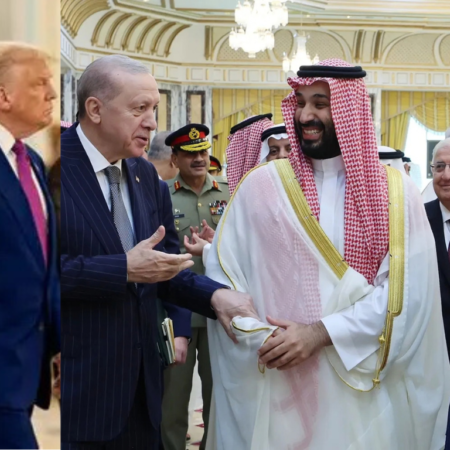
In August, Pakistan, Saudi Arabia and Türkiye signed the Makkah Joint Defence Agreement. Following renewed fighting in Yemen and Houthi attacks on Saudi targets, the partners agreed to move toward deploying military capabilities in Saudi Arabia. Pakistan’s stated position is that the arrangement is defensive; Pakistani officials have said Saudi forces are conducting combat operations, while reporting has described Pakistani support roles and cited an anonymous official alleging that Pakistani fighter jets were used against the Houthis. Islamabad has called that air-force claim “fake and fabricated.” The precise scale and operational scope of Pakistan’s role therefore remain contested.
The Houthis have warned Pakistan and Türkiye against supporting Saudi Arabia, according to the Institute for the Study of War. That is serious enough to merit attention, but it is not the same as a formal declaration of war on Pakistan. The transcript’s claim that Houthi missiles could soon strike Karachi, and its assertions about captured Pakistani personnel and a large troop deployment, should not be repeated as established fact without independent confirmation. The distinction is not pedantry: alarmist framing can obscure the more consequential policy question—how far Pakistan’s defensive commitment might draw it into an offensive campaign in Yemen.6 8
That question has a domestic dimension. In 2015, Pakistan’s parliament debated Saudi Arabia’s request for military assistance in Yemen and voted for neutrality in the conflict, while affirming support for Saudi territorial integrity. The contrast with today’s opaque operational claims is striking. Even where confidential planning is necessary, electedrepresentatives should be able to scrutinise the legal basis, mission, limits, risks and exit conditions of overseas deployments. Parliament’s role is not a ceremonial obstacle to speed; it is how a state distributes responsibility for decisions that may expose its troops and citizens to retaliation.
An Economy With No Cushion, and a Map Being Redrawn
Beneath the political turmoil lies a fragile economy, particularly vulnerable to external shocks. The war between Iran and the United States, which began in February, has hit Pakistan hard, given its heavy dependence on imported energy and limited foreign exchange reserves. Petrol prices surged from Rs 266 per litre on 1 March to Rs 393.75 on 22 September—an increase of nearly 48 per cent—with prices now being revised daily, according to Arab News. Meanwhile, gas shortages have forced textile mills to shut down, while smuggled Iranian fuel has become a critical source of domestic supply. Pakistan’s inadequate refining capacity and limited storage infrastructure further constrain its ability to absorb sudden disruptions in energy supplies, exposing the structural vulnerabilities of its economy…
China could bypass this vulnerability skeptically. Beijing has reportedly begun upgrading a road link through Afghanistan’s Wakhan corridor, a sign that it is hedging beyond the China-Pakistan Economic Corridor. Yet, drawing on his own experience of crude oil logistics, Devasher argued that moving oil by road or pipeline across the Karakoram at altitudes up to 6,000 metres, with passes closed by snow for months, was never commercially credible. A far easier route to Bandar Abbas already exists through Central Asia.
The proposed 28th Amendment has been reported as a vehicle for creating new provinces or administrative units, with Sindh’s boundaries the most contentious question. Sindh’s assembly unanimously rejected any territorial change on 3 September, and the PPP, a pillar of the federal coalition, opposes splitting the province. the KP act as a laboratory: a test of whether subdividing a province weakens its political identity. General Zia-ul-Haq once told an American author he would ideally divide Pakistan into 53 provinces so that ethnicity would cease to matter. The reasoning, misreads the lesson of 1971. Provincial autonomy strengthens federations, and its denial helped break the old one.
What It Means for India
New Delhi has every reason to watch closely, and every reason to resist triumphalism.
The comparison with Bangladesh invoked is evocative but premature. East Pakistan was geographically separate, and the Pashtuns are entwined with the Pakistani state through the army, the bureaucracy and commerce. The risk is not a secession next year but a slow erosion of consent in a province that has long supplied soldiers and officers to the federation.
All these crises should not be collapsed into one. A provincial emergency is not a proxy war, and a Saudi defence pact does not prove that Pakistan is fighting the Houthis. They do, however, share a governing habit: consequential decisions are presented as security imperatives, while the public and representative institutions are left to infer their scope. That habit may create short-term room for manoeuvre. Over time it can weaken trust, blur accountability and make every dispute harder to resolve without force.
Pakistan’s leaders face genuine dangers—from militant violence at home to regional escalation abroad. But danger does not suspend the need for political consent; it makes consent more valuable. If the emergency in KP is temporary, narrowly tailored and subject to transparent review, the government should be able to demonstrate that. If Pakistan’s role in Saudi Arabia is strictly defensive, Islamabad should state the boundary clearly and bring Parliament into the decision. A federation is not made safer by silencing its provinces, and a defence commitment is not made safer by concealing its costs. Control can contain a crisis. Only credible institutions can prevent it from returning.