
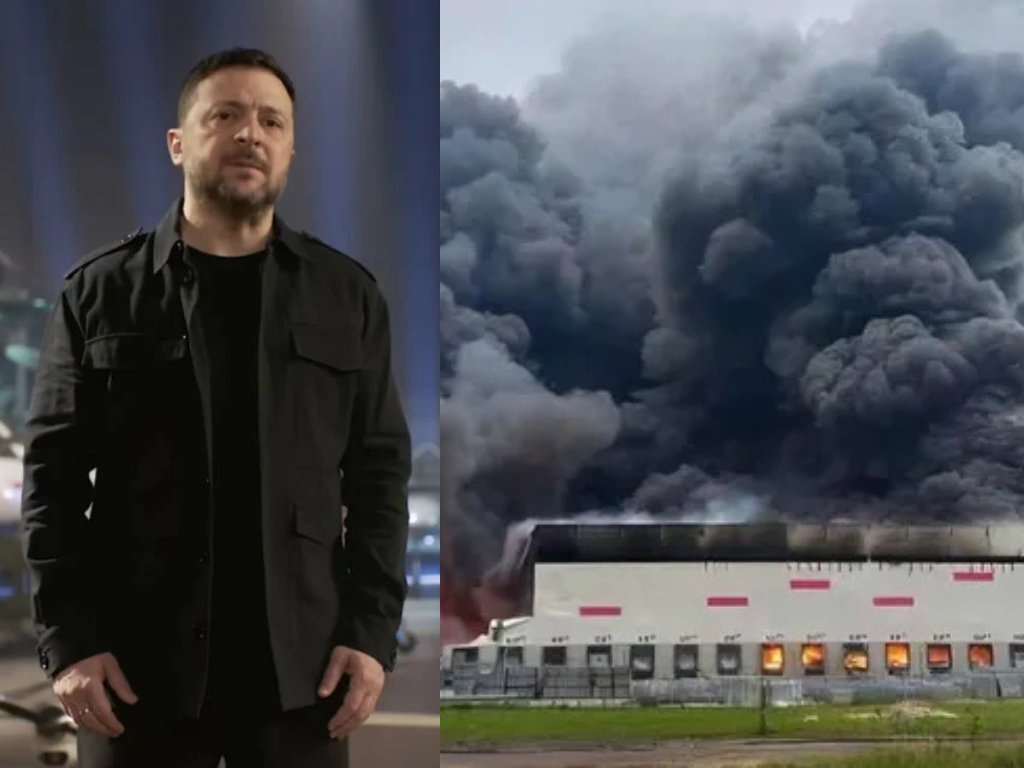
Ukrainian drone strikes targeting major data centres operated by Yandex, Russia’s technology giant, have triggered widespread service disruptions and a sharp decline in traffic originating from its network. The development has raised questions about whether the attacks have also disrupted Russian-linked social media bot networks accused of spreading disinformation across the internet.
According to reports citing internet infrastructure company Cloudflare, traffic associated with Yandex’s network fell dramatically following a series of Ukrainian attacks on the company’s data centre infrastructure. The decline has fuelled speculation that the facilities may have supported automated online activity, including networks of accounts used to amplify political messaging and influence public opinion.
Ukrainian Strikes Disrupt Yandex Infrastructure
Ukraine reportedly targeted a major Yandex data centre in Sasovo, in Russia’s Ryazan region, on October 8, 2026. The facility houses critical computing infrastructure supporting the company’s cloud services and artificial intelligence operations.
Reports subsequently indicated that another Yandex facility in Kaluga was targeted on October 9, followed by further disruption to the company’s infrastructure. The attacks have affected several services operated by Yandex, including cloud computing, databases, storage, artificial intelligence systems and other digital platforms.
Yandex, often described as Russia’s equivalent of Google, operates a broad technology ecosystem encompassing search, mapping, financial services, food delivery, cloud computing and AI-powered applications.
The disruption has highlighted the strategic importance of commercial data centres, which serve as the backbone of modern digital economies. Beyond consumer-facing services, these facilities provide computing capacity for businesses and support a range of applications that depend on reliable data storage and processing.
The attacks have also raised questions about the vulnerability of concentrated digital infrastructure during wartime, particularly when a single company supports multiple essential online services.
Did Russian Social Media Bots Disappear?
The reported decline in Yandex-associated traffic quickly attracted attention on social media, where users claimed to have noticed fewer suspicious accounts and politically charged posts.
Ukrainian President Volodymyr Zelensky also highlighted the apparent reduction in online hostility and provocative content while addressing the Warsaw Security Forum in Poland. He suggested that fewer bots might explain why social media feeds appeared less divisive following the attacks.
Some European commentators subsequently pointed to the apparent decline in online activity surrounding political movements, including Germany’s right-wing Alternative for Germany (AfD), as a possible indication that Russian-linked influence operations had been affected.
The claims gained momentum after Cloudflare data showed a steep fall in HTTP requests originating from Yandex’s network. Reports cited a decline to approximately 0.4% of the maximum traffic recorded during the preceding two weeks.
However, the figures require careful interpretation. A fall in requests from a particular network does not necessarily mean that an equivalent proportion of social media bots has gone offline.
HTTP requests measure attempts to access websites and online services. Such traffic can include automated crawlers, search-engine indexing systems, legitimate software processes and other forms of automated activity, in addition to potentially malicious operations.
Why Cybersecurity Researchers Are Cautious
Cybersecurity researchers have warned that the relationship between data centre outages and social media manipulation is more complicated than it might initially appear.
Aras Nazarova, a senior security researcher at Cybernews, said that a direct connection between the attacks on Yandex infrastructure and changes in Russian disinformation activity could not be established from the available evidence.
Disinformation campaigns often rely on fake social media profiles designed to resemble genuine users. Operators may employ virtual private networks (VPNs), proxy servers and other techniques to conceal the origin of their activity.
These methods can allow operators to shift infrastructure or move operations between different networks when a particular service becomes unavailable.
Pieter Arntz, a researcher at cybersecurity company Malwarebytes, also cautioned against confusing general automated internet traffic with state-sponsored social media activity.
Cloudflare’s measurements of traffic associated with Yandex’s network do not reveal how many social media accounts are publishing content, how many users are browsing platforms or whether specific influence operations have ceased.
Establishing a direct link would require account-level activity data, evidence identifying the affected accounts and technical information connecting those accounts to the disrupted infrastructure.
Russia’s Digital Infrastructure Becomes a Wartime Target
The attacks on Yandex facilities highlight an expanding dimension of the Russia-Ukraine conflict: the targeting of digital infrastructure far from the battlefield.
Since Russia launched its full-scale invasion of Ukraine in February 2022, both sides have increasingly employed drones and other long-range weapons against targets deep inside enemy territory. Commercial infrastructure has also become more exposed as digital services assume greater importance in economic activity and national security.
Data centres are particularly significant because they concentrate computing power, storage systems and network connections in large physical facilities. Damage to such sites can disrupt multiple services simultaneously, affecting businesses, consumers and government-linked operations.
The latest strikes also come amid reports of attacks on Ukrainian data infrastructure by Russian forces. These developments underscore the growing vulnerability of civilian digital assets in a conflict where cloud computing, artificial intelligence and online communication have become increasingly important.
Nevertheless, the strategic implications of attacks on commercial data centres depend on the functions performed by the affected facilities and the extent to which their infrastructure supports military or other sensitive operations.
What the Decline in Bot Traffic Actually Means
The reported fall in Yandex-associated traffic offers evidence of disruption to a segment of Russia’s digital infrastructure. It does not, however, provide sufficient evidence to conclude that Russian disinformation campaigns have suffered a comparable setback.
Some automated operations may have been affected by the outages, particularly those dependent on the disrupted infrastructure. Others may continue through alternative hosting providers, proxy networks or other technical arrangements.
A reliable assessment would require researchers to identify suspicious accounts, examine their posting patterns before and after the attacks, and determine whether their activity was technically dependent on the affected Yandex facilities.
Until such evidence becomes available, claims that Ukraine has significantly weakened Russian social media influence operations remain unverified.
The broader significance of the attacks lies in their demonstration of how modern warfare can disrupt interconnected digital systems. Data centres are no longer merely commercial facilities supporting everyday internet services; they are critical infrastructure whose disruption can have consequences across the economy, technology sector and information environment.
Whether the strikes have also reduced Kremlin-linked online manipulation remains an open question.