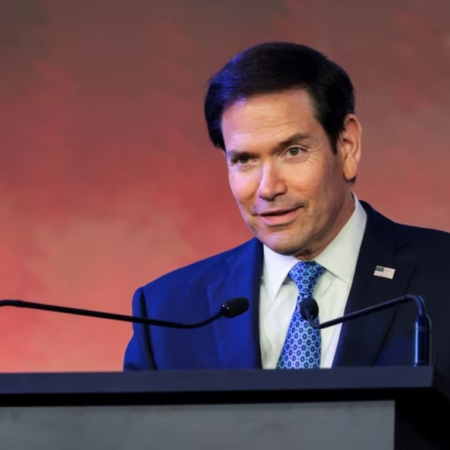

Marco Rubio Calls India a ‘Refining Superpower’: Why Jamnagar Could Become a Strategic Asset in the Global Oil Crisis

US Secretary of State Marco Rubio’s description of India as a “refining superpower” is more than a diplomatic compliment. It reflects a strategic reality: in an increasingly volatile global energy market, the ability to convert difficult-to-process crude oil into usable fuels can be as important as access to oil reserves themselves.
During his ongoing India visit Rubio highlighted India’s sophisticated refining capabilities and Reliance Industries’ importance to the global energy industry. Ahead of his scheduled visit to Reliance’s Jamnagar refinery in Gujarat, he discussed how Indian companies could help process additional supplies of Venezuelan crude oil.
The timing is significant. Escalating tensions in West Asia, disruptions to oil infrastructure and uncertainty surrounding international crude supplies have increased the importance of countries capable of maintaining the flow of refined petroleum products. Washington’s interest in India’s refining industry demonstrates how energy security can create new avenues for strategic cooperation.
However, the significance of Rubio’s remarks extends beyond the immediate crisis. They raise a larger question: can India use its refining capabilities to strengthen its position in global trade, energy diplomacy and industrial competitiveness?
Why Marco Rubio Called India a Refining Superpower
India occupies a distinctive position in the global oil economy. It imports substantial quantities of crude oil, processes that crude in domestic refineries and exports petroleum products to international markets.
According to the figures cited by Moneycontrol, India accounted for approximately 4.7% of global refining capacity in 2025. The country’s installed refining capacity stood at 267.1 million tonnes per annum in April 2026, with plans to increase it to 309.5 million tonnes per annum by 2030.
This infrastructure gives India an advantage that countries possessing large oil reserves do not automatically enjoy. Crude oil must be processed before it can become petrol, diesel, aviation fuel and other commercially useful products. The ability to refine different grades of crude efficiently determines how effectively a country can convert imported energy resources into valuable outputs.
Rubio acknowledged this advantage while discussing Venezuela’s energy potential. He explained that Indian companies have the capacity to process heavy crude and that some have existing experience and commercial interests connected to Venezuelan oil.
His remarks also contained an important qualification: Venezuelan oil alone cannot compensate for every disruption affecting global energy supplies. India’s refining capacity can provide additional flexibility, but it cannot eliminate the consequences of a prolonged international energy crisis.
Jamnagar Refinery: India’s Strategic Advantage
At the centre of this discussion is Reliance Industries’ Jamnagar refining complex in Gujarat.
Reliance operates two refineries at Jamnagar, with a combined installed capacity of approximately 68.2 million tonnes per annum. The complex serves both the domestic market and international export markets.
Its significance lies not simply in its size but in its ability to process a wide variety of crude grades. Refinery configuration determines which types of crude can be processed efficiently and which technologies are required to extract valuable products.
Venezuelan crude presents a particular challenge. Much of the oil produced in the Orinoco Belt is heavy or extra-heavy, with high viscosity and, in many cases, substantial sulphur content. Processing such crude requires specialised equipment and sophisticated conversion technologies.
These can include cokers, hydrocrackers and other units that help transform heavier petroleum fractions into more valuable products.
This is where Jamnagar becomes strategically relevant.
The complex is widely recognised for its advanced configuration and ability to process challenging crude grades. Its scale, export infrastructure and integration with international markets make it an important asset in any discussion about expanding the processing of Venezuelan oil.
The Nelson Complexity Index (NCI) provides one way to understand this advantage. It measures a refinery’s complexity relative to a simple distillation refinery, taking account of the types and relative capacities of its processing units.
Jamnagar is frequently cited with an NCI of approximately 21.1, reflecting its highly complex configuration. This figure is a useful indicator of its technical capabilities, although the index alone does not establish that a refinery is superior in every operational, commercial or environmental measure.
The broader point remains: advanced refineries can process a wider range of crude grades, potentially giving their operators greater flexibility when international supply patterns change.
Why Venezuelan Oil Matters to Washington
Venezuela possesses enormous petroleum resources, particularly in the Orinoco Belt. Yet the composition of its crude creates technical and commercial challenges.
Heavy and extra-heavy crude generally requires more complex processing than lighter grades. Its economic attractiveness depends on factors such as its price discount, transportation costs, availability of suitable refinery capacity and the market value of the resulting products.
For the United States, increasing Venezuelan oil production and finding reliable buyers and processors could help diversify supply options. Indian refiners offer a potential commercial partner because certain facilities are equipped to handle heavier crude grades.
India has also resumed purchases of Venezuelan crude following an easing of US restrictions earlier in 2026. Indian imports from Venezuela reached approximately 201,000 barrels per day in September.
These developments could create opportunities for Indian refiners, but a sustained increase in purchases is not guaranteed. Commercial decisions will depend on the price of Venezuelan crude relative to competing supplies, the cost of transporting it, refining margins and the applicable sanctions and licensing framework.
It would therefore be premature to conclude that India will necessarily replace Russian crude with Venezuelan oil on a large scale. A more plausible outcome is a diversified sourcing strategy in which Indian refiners adjust their purchases according to price, availability and technical requirements.
India’s Energy Diplomacy Could Gain Momentum
Rubio’s visit also illustrates how energy infrastructure can shape diplomatic engagement.
India and the United States have interests in reliable fuel supplies, commercially viable energy trade and the resilience of global markets. India’s refining capacity offers a practical basis for cooperation, while American efforts to expand Venezuelan oil production and sales could create additional commercial opportunities.
At the same time, India must protect its own energy interests. Its decisions cannot be determined solely by Washington’s requirements. Crude procurement must remain commercially viable, and energy security requires access to multiple suppliers.
Russia, West Asia, the Americas and other producing regions will continue to matter to Indian refiners. The most effective strategy is not necessarily to replace one supplier with another, but to preserve the flexibility to respond to changing market conditions.
India’s petroleum exports add another dimension.Data from the Petroleum Planning and Analysis Cell, reported that India exported 61.5 million tonnes of petroleum products in FY2026, compared with 65.1 million tonnes in FY2025.
These exports demonstrate how refining converts imported crude into products that earn revenue in international markets. However, the financial benefits depend on refining margins, domestic demand, global product prices and the cost of crude imports.
A sustained expansion of exports could support foreign-exchange earnings, but it would not automatically strengthen the rupee. Currency movements also depend on the broader balance of payments, capital flows, monetary policy and global risk sentiment.
The Contradiction in America’s Approach to India
There is also a wider political dimension to this relationship.
India’s industrial infrastructure can contribute to American energy objectives even as trade disagreements, tariffs and domestic political rhetoric rising racism against Indians complicate bilateral relations. Rubio’s remarks underline the practical importance of cooperation, but they should not be interpreted as proof that every disagreement between the two countries has disappeared.
Despite so much negativity, racism by against India and Indians especially by Trump backed MAGA fraction India behaving as responsible power helping US to rescue to global oil crisis.
For India, the lesson is straightforward: strategic capabilities create negotiating leverage when other countries have a clear commercial or security interest in them.
Refining is one such capability. India has invested in large, complex industrial facilities that serve its domestic economy while connecting it to global markets. Their importance becomes more visible when disruptions elsewhere expose weaknesses in the international energy system.
The same principle applies to manufacturing, pharmaceuticals, digital infrastructure, defence production and critical technologies. Countries gain influence not merely by possessing resources, but by developing the infrastructure, expertise and industrial capacity that others need.
A Major Opportunity, but Not a Complete Solution
India’s refining industry could benefit if Venezuelan crude supplies increase and international buyers continue to seek reliable sources of refined petroleum products. Jamnagar’s capabilities put it in a strong position to participate in this trade, provided the economics and regulatory conditions are favourable.
But there are limits to what refining can achieve.
Indian refineries still depend on imported crude. Higher international oil prices can raise the country’s import bill and increase pressure on domestic fuel costs. Refining margins can fluctuate, while disruptions to shipping routes, crude production or refinery operations can constrain the supply of petroleum products.
Nor can Venezuelan oil alone compensate for every shortfall caused by conflict in West Asia or damage to Russian energy infrastructure.
The opportunity, therefore, lies in resilience rather than a guaranteed windfall. By maintaining access to multiple crude suppliers, investing in advanced refining technology and expanding commercially viable exports, India can strengthen its position in the global energy market.
Marco Rubio’s description of India as a “refining superpower” captures this emerging reality. The phrase recognises the strategic value of an industrial capability that is often overlooked in discussions focused exclusively on oil reserves and production.
Jamnagar is not merely a refinery processing imported crude. It is part of the infrastructure through which India participates in the global energy economy.
As geopolitical uncertainty continues to reshape oil markets, that capability could become an increasingly important source of economic opportunity and diplomatic influence. The real test will be whether India can convert this recognition into durable commercial gains while protecting its own energy security.