
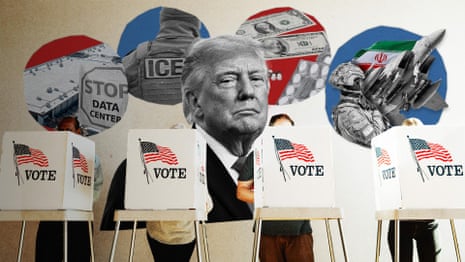
US Mid Terms: Will the Iran war, economic inflation and MAGA’s Racial rhetoric sink Trump and the Republicans? Or will the Democrats fail again?

Early voting has begun in Texas, and the stakes extend far beyond the state’s borders. The November 3, 2026, midterm elections could reshape the balance of power in Congress, challenge Republican dominance in Texas, and reveal whether Donald Trump’s MAGA movement is losing its grip on the American electorate.
Texas early voting runs from October 19 through October 30. Voters face consequential contests for the U.S. Senate, governor, Congress, and other statewide offices.
Inflation, fuel prices, healthcare, abortion, public safety, political scandals and congressional redistricting are some of the major factors influencing voters.
Another big question is whether MAGA’s confrontational political style including rhetoric criticized as racist, anti-immigrant and exclusionary will provoke a backlash strong enough to weaken Republican power.
These issues may reinforce one another. A voter who already feels financially insecure may become more dissatisfied with an administration that appears focused on cultural conflict.
A Latino voter who supported Trump because of economic promises may reconsider that choice if household costs remain high or immigration policies affect their family or community. A suburban voter who prioritizes stability may become uncomfortable with increasingly aggressive political rhetoric.
The defining question of 2026 is whether dissatisfaction with the economy and backlash against political extremism will combine to produce an electoral shift large enough to change control of Congress and make Texas competitive.
The economy and the Iran war factor
The economic conditions currently prevailing in USA could hold perhaps a central influence on the midterms.
A Reuters/Ipsos poll reported on October 19 put Trump’s approval rating at 31%, its lowest level across his two presidential terms. The survey found that registered voters preferred Democratic congressional candidates by 47% to 35%. It also reported widespread dissatisfaction with Trump’s handling of the economy, with gasoline prices among the concerns.
When voters feel economically squeezed, they may become less willing to tolerate political conflict that appears unrelated to their daily needs.
This creates an important connection between economic dissatisfaction and backlash against extremism. Racially divisive rhetoric may energize some supporters, but it may fail to persuade voters who are primarily concerned about their household budgets.
If voters conclude that the administration has concentrated on political confrontation while failing to deliver economic improvements, Republicans could lose support among independents and some traditionally Republican voters.
A large portion of the country is currently majorly dissatisfied with the US Iran clash.
The Fox News survey showed 75% of respondents were either “extremely” (42%) or “very” (33%) concerned about the war in Iran. According to the AP-NORC poll, 62% of registered voters named the war as one of the most important issues.
The Fox poll further found that six in 10 voters oppose U.S. military action against Iran, and those voters favor Democratic congressional candidates by 56 points.
Some of the specific economic concerns voters mentioned, including gas prices and the cost of living, have been driven by an energy crisis fueled by disruptions in the Strait of Hormuz, blurring the line between economic and foreign-policy concerns.
Candidate controversies and the Latino vote
Elections are not only judgments on policies. They are also judgments on the character and credibility of candidates.
Texas provides a striking example in the Senate contest between Democrat James Talarico and Republican Ken Paxton.
Paxton’s political record has been overshadowed by controversies, including his impeachment by the Texas House in 2023 and subsequent acquittal by the state Senate. Talarico’s campaign has sought to appeal to voters beyond the Democratic base.
A University of Texas poll reported in October showed Talarico narrowly ahead of Paxton, while other surveys have produced differing results. A separate report highlighted erosion in Paxton’s support among some suburban women.
These developments suggest that Republican vulnerabilities may involve more than dissatisfaction with Trump or MAGA ideology. Questions about integrity, leadership and personal conduct can influence whether voters remain loyal to a party.
Latino voters could be among the most consequential groups in the 2026 elections, especially in Texas.
A Reuters report published in September described growing frustration among some Latino voters in South Texas over economic pressures and Trump’s immigration agenda. The reporting raised questions about whether the Republican gains of 2024 would endure through the midterms.
If voters who supported Trump now believe that his policies have failed to improve their financial circumstances—or that immigration enforcement has become excessively harsh—their willingness to support Republican candidates could weaken.
Racial rhetoric may intensify that dissatisfaction when voters believe it threatens their families, communities or equal treatment under the law.
The question of Racism
Race has long been a contentious issue in American politics. During Trump’s political rise, his rhetoric about immigrants, national identity, crime and cultural change became a central part of his appeal to supporters and a major source of criticism from opponents.
MAGA supporters often describe their movement as an effort to restore national strength, enforce immigration laws and defend traditional values. However it is argued and now seen that a lot of its language and policies stigmatize racial minorities, portray immigrants as threats and encourage hostility toward political opponents.
The electoral consequences of such actions could be significant. When political rhetoric is perceived as dehumanizing or discriminatory, it can motivate affected communities to vote, volunteer, organize and persuade others to participate. It may also alienate independents and moderate voters who dislike racial hostility, political intimidation or attacks on democratic institutions.
This backlash could be particularly important in competitive suburban districts and statewide contests, where relatively small shifts in voter preferences can determine the winner.
Racism against Indian Americans
One issue that deserves greater attention in the 2026 midterms is the treatment of Indian Americans and people of Indian origin amid America’s increasingly polarized debate over immigration, race, national identity and economic competition.
Yet Indian-origin communities are not immune to racial prejudice. Anti-Indian hostility has now taken several forms: racial slurs, xenophobic attacks, online harassment, stereotypes about technology workers, resentment over employment and H-1B visas, and claims that people of Indian origin do not genuinely belong in American society.
Indian American voters are politically diverse. Many support Democrats because of their views on immigration, civil rights, healthcare or social policy. Others support Republicans because of economic priorities, entrepreneurship, taxation, religious values, foreign policy or national security.
There is no single Indian American political position. However, racial hostility can make an otherwise abstract election personal. A voter who previously prioritized taxes or business regulation may also consider whether a candidate condemns racial harassment, protects equal rights and rejects collective blame directed at an ethnic community.
The is doubly true of families whose children experience bullying, workers who face discrimination, and citizens who are told they do not belong despite having lived in the United States for decades.
If voters believe a party is tolerating racial hostility for political advantage, that perception could destroy its support base.
Redistricting and What the national polls tell us
Texas Republicans have pursued new congressional district boundaries intended to improve the party’s prospects in several seats. The strategy has become part of a wider national fight over the drawing of electoral maps.
Redistricting can influence election outcomes by changing which voters are grouped together in a district. But it does not eliminate political uncertainty.
If Republican mapmakers overestimate the durability of their coalition, district changes intended to protect the party could produce less reliable results than expected.
Nevertheless, redistricting makes it especially important to distinguish a statewide shift in public opinion from changes in individual House districts. Democrats could make gains in some districts without winning Texas statewide, and Republicans could retain statewide strength while losing selected congressional seats.
Pew Research Center’s October 8 report found that registered voters preferred Democratic congressional candidates by 44% to 36%. Reuters/Ipsos reported a larger Democratic lead on October 19, at 47% to 35%.
Still, national polling does not determine which party wins each state or congressional district. Local candidates, turnout, campaign spending, electoral geography and district boundaries all matter.
The Senate is particularly difficult for Democrats to capture because they must win individual statewide races in a range of political environments. The House may offer a different path, depending on the number and location of competitive districts.
Republicans or Democrats who gains?
Texas could become an important test of whether national dissatisfaction with Trump translates into concrete electoral gains in a traditionally Republican state.
The 2026 midterms could become a turning point for Trump’s political movement, particularly if dissatisfaction with the economy combines with a backlash against racial division, aggressive immigration policies and political controversies.
The strongest evidence of Republican vulnerability is not that any one issue will automatically defeat MAGA. It is that several sources of dissatisfaction may be converging at the same time, while national polling indicates a substantial Democratic advantage.
However all these issues do not automatically translate into a votebank for the Democrats, Texas has long been a Republican stronghold and in the previous Presidential election they were soundly beaten nationally by the Republicans under Trump. It is still a question whether those voters are now in under 2 years, dissatisfied enough to flip the results.
Texas could become the clearest test of whether that convergence is strong enough to break Republican dominance. A Democratic victory would be historic, but the race remains competitive and its outcome uncertain.
Ultimately, the midterms will measure more than the public support for Trump. This will also be a filter test to gauge the country’s current real mood. Have Trump and the Republicans lost major ground or is it all just a narrative mirage created by Democrats. The results will soon make it crystal clear.


Ukraine Gave Russia Its Bombers. Now Moscow Uses Them to Attack Kyiv