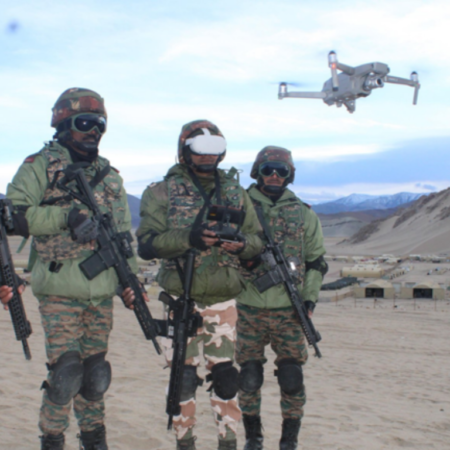
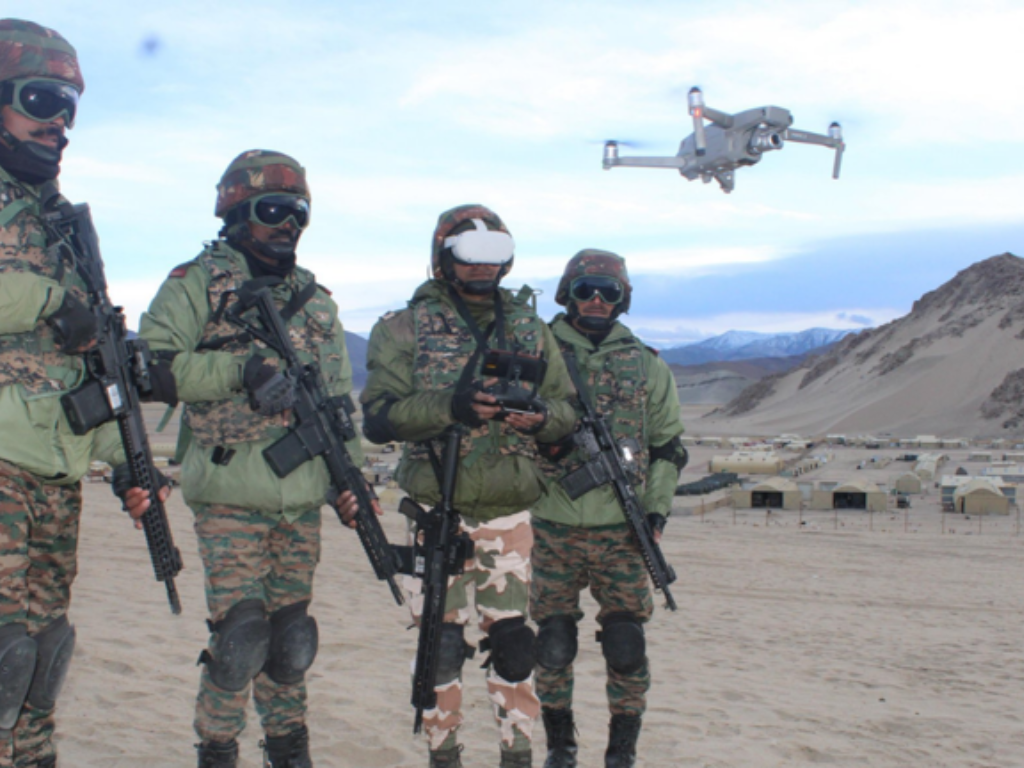
India’s security challenge along the China border is evolving beyond conventional military confrontations, with drone warfare emerging as a critical component of future conflicts. The growing technological capabilities of the People’s Liberation Army (PLA), combined with China’s extensive drone manufacturing ecosystem, could give Beijing a significant advantage in a prolonged conflict unless India accelerates its own drone and counter-drone capabilities.
On October 22, Indo-Tibetan Border Police (ITBP) chief Shatrujeet Singh Kapoor warned that the threat from China continued to persist. Addressing ITBP personnel in Alwar, Rajasthan, he reportedly referred to recent face-offs between Indian and Chinese troops at several locations in Arunachal Pradesh. He also stressed that conventional military methods alone would not be sufficient to address the challenges posed by China’s modernising military.
His emphasis on strengthening drone and anti-drone capabilities highlights a critical shift in modern warfare: the threat is no longer determined solely by the sophistication of a weapon, but also by how cheaply, quickly and extensively it can be produced and deployed.
How Drone Warfare Is Changing Modern Combat
The Russia-Ukraine war, which began in February 2022, has demonstrated how unmanned aerial systems can transform battlefield operations. Initially used primarily for short-range reconnaissance, surveillance and attacks, drones have evolved into increasingly sophisticated platforms capable of conducting long-range precision strikes.
Advances in propulsion, communications, navigation and machine vision have expanded their operational reach. Some long-range drones can now perform missions that overlap with those of cruise missiles, while generally offering different cost, production and deployment advantages.
Medium-altitude, long-endurance drones have also provided reconnaissance and strike capabilities. However, their effectiveness can be constrained by sophisticated air-defence systems, encouraging their use for intelligence gathering and target acquisition in heavily defended environments.
Smaller drones present a different challenge. Their low cost, limited physical signatures and ease of deployment can make them difficult to detect and track consistently. When deployed in large numbers, they can stretch air-defence resources and force militaries to expend expensive interceptors against comparatively inexpensive targets.
For India, these developments have particular significance along the mountainous Line of Actual Control (LAC), where difficult terrain, long supply routes and demanding operational conditions increase the importance of persistent surveillance and reliable logistics.
Why China’s Industrial Capacity Matters
China’s potential advantage lies not merely in its ability to develop advanced drones, but in the industrial ecosystem supporting their production.
According to defence analyst Vijainder K. Thakur, China possesses substantial capabilities across critical drone technologies, including electric motors, flight controllers, sensors, navigation systems, communications modules and propulsion.
This manufacturing depth could enable China to produce drones in large numbers, adapt designs to battlefield requirements and introduce modifications faster than countries dependent on limited production capacity or imported components.
In a conflict along the India-China border, such capabilities could potentially be used to monitor troop movements, target supply convoys and threaten military infrastructure. Radars, artillery positions, armoured vehicles and forward logistics facilities could also face increased exposure to persistent drone surveillance and attacks.
The challenge would extend beyond the immediate border. Long-range precision-strike drones could potentially threaten airbases, radar installations, air-defence units and logistics facilities in India’s rear areas. The actual effectiveness of such operations, however, would depend on the drones deployed, the intelligence available, the terrain and the ability of Indian forces to disrupt or intercept them.
China’s experience in drone networking and its broader communications infrastructure could provide additional advantages. However, the contribution of individual technologies, including satellite constellations, to specific military operations would depend on their integration and performance under combat conditions.
The Technology Behind Effective Drone Warfare
Developing a drone with impressive specifications does not automatically translate into battlefield superiority. Effective drone warfare requires the integration of several technologies tailored to particular operational objectives.
Propulsion: Efficient and affordable engines determine a drone’s speed, range and endurance. Different missions require different combinations of these capabilities.
Communications: Reliable communication links enable remote control, coordination and target engagement. Relay networks, mesh networking and satellite communications can extend operational reach, although electronic warfare can disrupt these systems.
Navigation: Satellite navigation can be vulnerable to jamming. Machine vision and terrain matching offer alternative ways to navigate using visual information and geographical features.
Precision targeting: Sensors and machine-vision technologies can help identify intended targets and improve engagement accuracy. Their effectiveness depends on the operating environment and the ability to distinguish legitimate military targets from other objects.
Mission-specific payloads: Different targets require different payloads and effects. A system designed to attack a moving supply vehicle may not be suitable for striking a bridge or another fixed installation.
These requirements also apply to counter-drone systems. Interceptors, electronic warfare equipment and other defensive technologies must be matched to the speed, size, flight profile and operational characteristics of the incoming threat.
Consequently, drone warfare is becoming a continuous contest between attack systems and the technologies designed to detect, disrupt or destroy them.
India’s Drone Challenge: From Development to Mass Production
India has expanded its focus on indigenous defence manufacturing, but the challenge identified by Thakur concerns the depth of its capabilities across the drone supply chain.
Developing individual platforms is only one part of the task. India also needs dependable domestic sources of critical components, advanced sensors, navigation systems, propulsion technologies and communications equipment. These capabilities must be supported by manufacturing capacity that can expand rapidly when operational requirements increase.
Production scale matters because drones are often expendable systems. A military that can field advanced platforms but cannot replace losses quickly may struggle to sustain operations against an adversary capable of producing large quantities of relatively inexpensive systems.
India must therefore strengthen both its offensive drone capabilities and its counter-unmanned aerial system (C-UAS) infrastructure. This includes improving surveillance, detection, identification, electronic warfare, interception and coordination between frontline units and higher military commands.
The objective should not simply be to match every Chinese platform individually. Instead, India needs a flexible ecosystem that can rapidly develop, test and deploy systems suited to the specific challenges of the Himalayan theatre.
Lessons From the Russia-Ukraine War
The Russia-Ukraine conflict offers an important warning about the limits of conventional air-defence planning. Despite Russia’s layered air-defence network, Ukraine has continued to conduct drone attacks against targets at varying distances.
These operations have benefited from intelligence, surveillance and reconnaissance capabilities, while Western assistance and satellite communications have supported some aspects of Ukraine’s military operations.
The comparison is not exact: the geography, military objectives and operational conditions of a potential India-China conflict would differ substantially. Nevertheless, the conflict illustrates how relatively affordable unmanned systems can impose sustained pressure on a better-equipped adversary when supported by effective intelligence, communications and production capabilities.
For India, the lesson is that air defence cannot rely exclusively on traditional systems designed primarily to counter aircraft and missiles. Counter-drone capabilities must become an integral part of military planning, especially for protecting forward deployments, supply routes and critical infrastructure.
The Strategic Stakes for India
China’s manufacturing scale and technological depth could become significant force multipliers in a future conflict. Its ability to produce drones in large numbers, modify them quickly and integrate them with reconnaissance and communications networks could place sustained pressure on Indian forces.
However, industrial capacity alone does not guarantee battlefield superiority. Operational effectiveness would also depend on training, intelligence, command structures, electronic warfare resilience, logistics and the ability to adapt under combat conditions.
India’s response must therefore combine indigenous research and development with scalable manufacturing, reliable supply chains and integrated offensive and defensive drone operations.
The central challenge is not simply to build better drones than China. It is to develop a system capable of producing, deploying, maintaining and replacing them at the pace demanded by modern warfare.
As the military balance along the LAC continues to evolve, India’s preparedness will increasingly depend on how effectively it can close the gap between technological innovation and industrial capacity. In a future conflict, the decisive advantage may belong not only to the country with the most sophisticated weapons, but also to the one capable of deploying them at scale and sustaining operations over time.