India Japan missile testing deal finalized, Is Japan looking to become a missile superpower?

With the growing indifference the United States seems to be showing to its military partners, many of its long term allies have now preemptively begun their preparations to stand on their own. Trump’s anti Canada stance, his dismissive approach towards NATO and his growing closeness with Xi Jinping and Putin has the US’ long term asian allies worried.
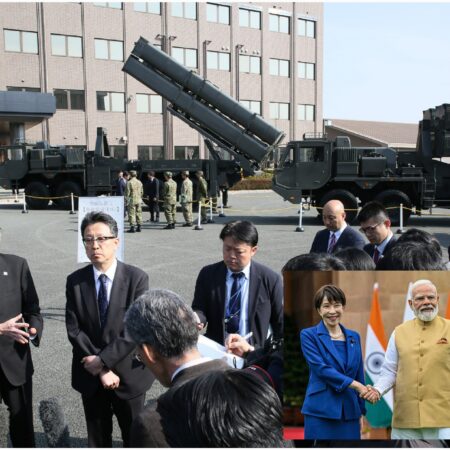
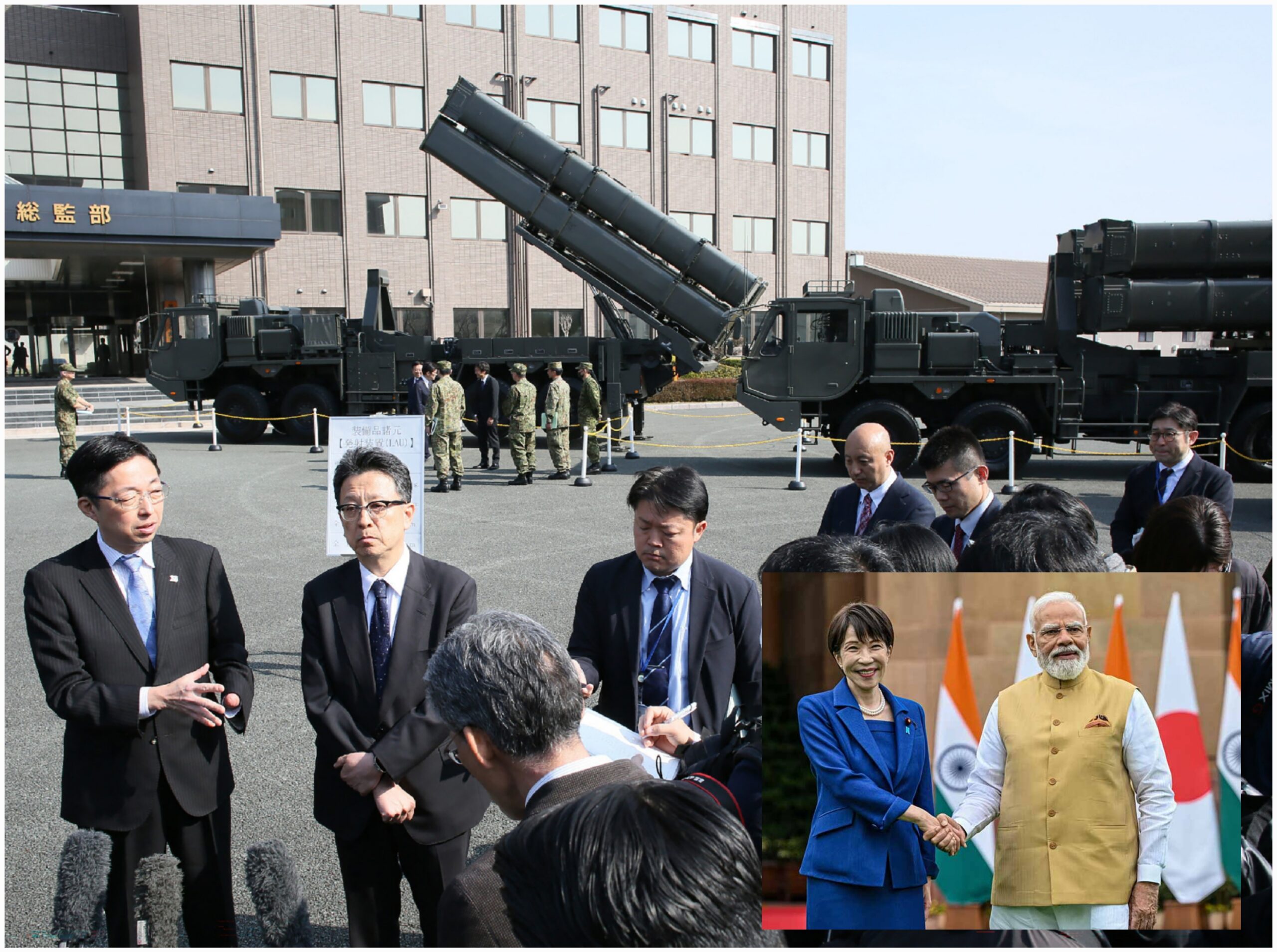
Japan is no different as Tokyo is now increasingly looking to become a major missile power, and its latest defence agreement with India is an important indication of that ambition.
But there is a distinction: Japan is not simply trying to build a larger missile arsenal. It is transforming its military from a predominantly defensive force into one capable of conducting long-range precision strikes and deterring potential adversaries.
The agreement allowing Japanese forces to conduct live-fire missile training at Indian firing ranges for the first time is significant in this context.
Why is Japan turning towards India?
On November 19, 2026, India and Japan signed a Letter of Intent concerning the use of Indian firing ranges by Japan’s Self-Defense Forces.
The agreement was announced following the India-Japan defence ministers’ meeting in Tokyo, attended by India’s Rajnath Singh and Japan’s Shinjiro Koizumi.
For Japan, this solves an important geographical problem.
As an island nation, Japan has limited space to conduct long-range missile testing and training. It is surrounded by adversaries, testing in the region will be taken as direct alerts for North Korea, China and Russia. On the other hand, in the subcontinent, India’s larger geographical area and established missile-testing infrastructure could provide Japanese forces with opportunities that are difficult to arrange domestically.
According to reporting by Defense News, Japan is particularly interested in training involving its long-range Type-25 surface-to-ship missile, which has a reported range of approximately 1,000 kilometres.
India has developed several indigenous missile families through the Defence Research and Development Organisation (DRDO).
These include:
Agni ballistic missiles, Prithvi ballistic missiles, BrahMos supersonic cruise missiles, Akash air-defence missiles, Astra air-to-air missiles and Pralay tactical ballistic missiles.
This gives India experience across several missile categories rather than dependence on a single weapons programme.
India also has experience operating tracking and telemetry infrastructure, including ground-based and ship-based monitoring.
This is relevant because Japan is looking for suitable locations to conduct long-range live-fire exercises.
Japan’s missile ambitions go far beyond this agreement
Japan has been steadily expanding its missile capabilities across several categories.
Here are the major developments:
1. Long-range Type-12 missiles
Japan is upgrading its Type-12 anti-ship missile into a much longer-range weapon.
The upgraded system is expected to have a reported range of around 900 kilometres or more, although the precise operational specifications have not been officially confirmed.
It is intended to provide Japan with greater stand-off strike capabilities against potential maritime threats.
2. Hypersonic weapons programme
Japan is also investing heavily in hypersonic technology.
Its programme includes the Hyper Velocity Gliding Projectile (HVGP), designed to travel at hypersonic speeds after separating from its rocket booster.
Tokyo is also developing a scramjet-powered hypersonic missile, with a development programme scheduled to continue until 2031.
These programmes demonstrate that Japan wants to develop advanced missile technologies rather than depend entirely on imported weapons.
3. Tomahawk cruise missiles
Japan is acquiring American Tomahawk cruise missiles, giving its military another long-range precision-strike capability.
The acquisition is particularly important because Japan has historically maintained a highly restrictive interpretation of its military role under its post-Second World War security framework.
The expansion of these capabilities represents a significant shift in Japanese defence policy.
Is Japan abandoning its pacifist military doctrine?
Not formally, but its interpretation of what constitutes self-defence is changing.
Japan’s post-war Constitution, particularly Article 9, renounces war as a sovereign right. However, Tokyo has increasingly argued that possessing the ability to strike enemy missile bases and military infrastructure can be necessary to defend the country.
This is the basis of Japan’s emerging counterstrike capability.
The strategy is driven by several security concerns:
China: Growing military activity around the East China Sea and tensions surrounding Taiwan.
North Korea: Continued development of ballistic and other advanced missile systems.
Russia: Military activity in the wider Indo-Pacific and its strategic partnership with China.
Japan wants potential adversaries to understand that an attack on Japanese territory could invite a much stronger military response.
With the US distancing itself from military engagements across the world Tokyo understands that any potential clashes in the future will require it to be ready to take on its adversaries on its own accord without any help from Washington or the west.
Why India-Japan missile cooperation matters
This is where the latest agreement becomes particularly interesting for India.
The November 2026 agreement is not limited to access to firing ranges. Both countries have also expressed interest in advancing defence research and development cooperation through India’s DRDO and Japan’s Acquisition, Technology and Logistics Agency (ATLA).
The two governments have specifically identified advanced missile and defence technologies as an area for cooperation.
Other areas include:
Defence manufacturing and technology transfer.
Naval shipbuilding.
Unmanned and autonomous systems.
Advanced communication technologies.
Air-domain awareness.
Importantly, although advanced missile and hypersonic technology cooperation is a potential area of interest, the official announcement does not confirm a joint hypersonic missile development programme.
Is Japan trying to compete with China militarily?
To an extent, yes. But Japan’s objective is better understood as building a credible regional deterrent rather than matching China’s entire missile arsenal.
China possesses a much larger and more diverse missile inventory, including ballistic, cruise and hypersonic systems.
Japan is instead concentrating on:
Longer-range precision-strike weapons.
Hypersonic missile technology.
Anti-ship capabilities.
Better intelligence, surveillance and targeting.
Greater cooperation with the United States, India and Australia.
The Indian firing-range agreement could help Japan overcome one of the practical obstacles to developing and training with these systems: access to suitable testing environments.
What does this mean for the Indo-Pacific?
The agreement has implications beyond bilateral relations.
India and Japan are both concerned about the changing military balance in the Indo-Pacific. Their growing defence cooperation could create new opportunities for technology development, defence manufacturing and military interoperability.
For India, the partnership could also strengthen its position as a defence technology and testing partner for friendly countries.
For Japan, access to Indian facilities could support its transition towards a more capable long-range missile force.
Japan is not yet a missile superpower however, its direction is unmistakable. It is moving away from an exclusively defensive military posture towards one with sophisticated long-range strike capabilities.
The combination of upgraded Type-12 missiles, Tomahawk cruise missiles, hypersonic weapons research and access to Indian firing ranges suggests that Tokyo is preparing for a much more demanding security environment.
The biggest takeaway: India is not simply opening its missile-testing infrastructure to Japan. It is becoming a more important defence partner in Japan’s effort to build an advanced missile capability.
The real strategic significance will depend on whether the two countries eventually move beyond training access towards joint research, technology development and defence manufacturing.