Soros invests $10 billion for regime change in India? Who is behind the Foreign Funded, Gen Z Protests demanding Regime Change across the world

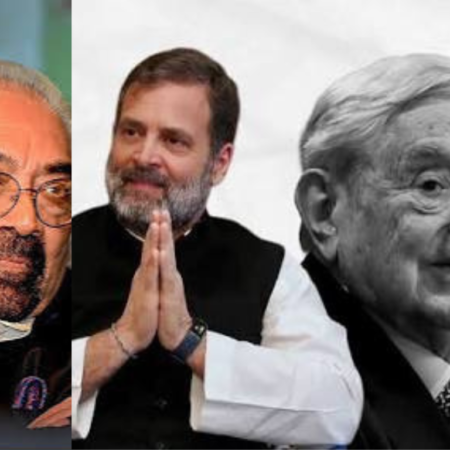
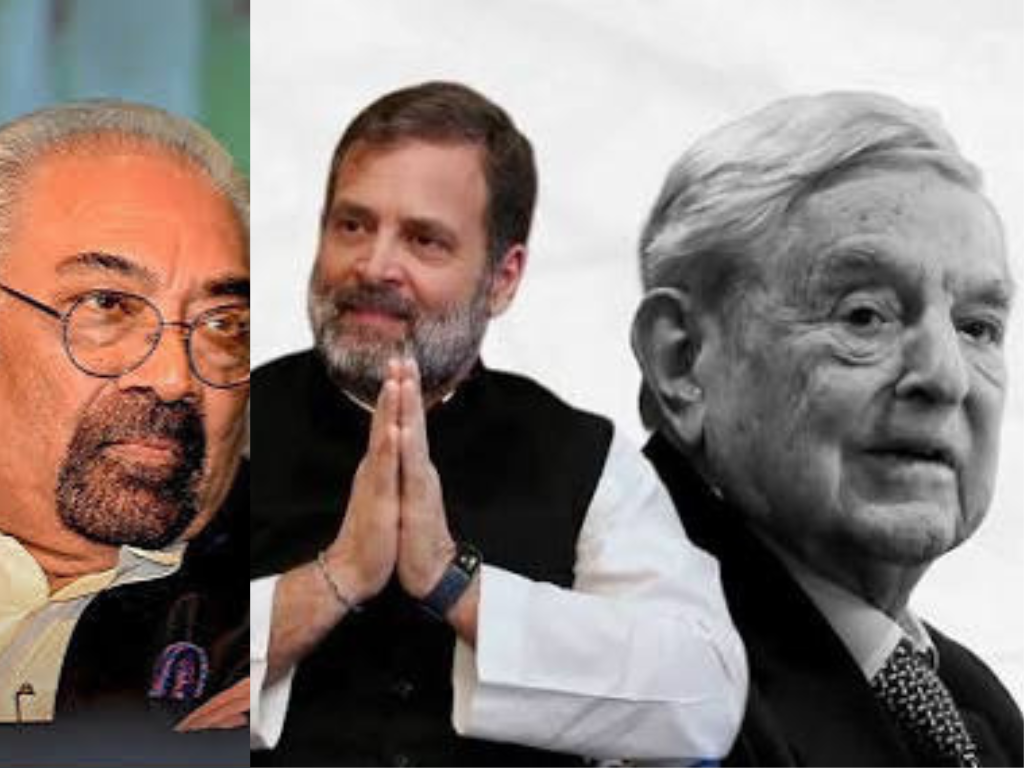
Indian Overseas Congress chief Sam Pitroda has once again triggered a political controversy by suggesting that a potential investment of $10 billion by billionaire George Soros could be considered if it served a beneficial purpose. While Pitroda framed the issue as a matter of government policy and economic priorities, the remark raises a larger question: how should India evaluate the influence of powerful foreign donors whose philanthropic networks have become subjects of political controversy across the world?
Speaking to IANS, Pitroda said, “If George Soros is going to bring in a 10-billion-dollar investment to do something good, maybe it’s one thing to look at.” He maintained that the decision would rest with the government in power and the objectives behind the investment. Pitroda also clarified that he had never met Soros and did not have a personal relationship with him.
He further argued that influential business figures could attempt to shape policies in their favour but did not necessarily control governments. His comments came alongside his defence of Rahul Gandhi’s social media exchange with Elon Musk over Starlink, insisting that it should not be interpreted as a commitment to grant the satellite internet company a licence.
However, the controversy surrounding Soros extends beyond the question of investment. It touches upon a broader debate about foreign money, political activism, civil society networks and the boundaries between legitimate democratic dissent and attempts to influence another country’s domestic politics.
The Soros Question: Investment or Political Influence?
George Soros, the Hungarian-American billionaire activities have also attracted criticism from governments and political movements that view his funding networks as an instrument of foreign political influence.
Nevertheless, foreign funding deserves scrutiny when it intersects with political mobilisation. India has legitimate reasons to demand financial transparency, enforce its foreign-contribution laws and examine whether overseas money is being used for activities prohibited under Indian law.
Pitroda’s statement was conditional: he said such an investment could be considered if it did something beneficial. Yet, given Soros’s politically contentious public profile, the suggestion inevitably raises questions about the safeguards that should govern any such engagement.
From Nepal and Bangladesh to India: Manufactured Youth Mobilisation Becoming a news Geopolitical toolkit
Across South Asia, youth-led protests have demonstrated the power of digital communication, public anger and street mobilisation to challenge established political structures. Nepal and Bangladesh have both experienced major political upheavals in which young protesters played significant roles.
Bangladesh is particularly relevant to India’s strategic calculations. The student-led uprising of 2024 culminated in the fall of Sheikh Hasina’s government, followed by the establishment of an interim administration under Muhammad Yunus. The episode demonstrated how quickly a staged political crisis can escalate when public anger, institutional distrust and mobilisation converge.
Analysts and evidences indicates subsequent political transition due to foreign influence, international interests and the forces that shaped the country’s future.
The existence of foreign diplomatic interests, overseas philanthropic networks or international engagement does prove that a protest movement was engineered from abroad.
The more important strategic lesson is that domestic instability can create opportunities for external actors to influence political outcomes, whether through diplomacy, information campaigns, financial networks or strategic partnerships. A country that fails to address public grievances can become more vulnerable to external influence, regardless of whether a particular protest has foreign backing.
For India, the lesson from Bangladesh is to treat every youth movement as a foreign conspiracy.Along with it, to recognise that domestic dissatisfaction and geopolitical competition can intersect, making transparency and institutional credibility essential to national stability.
Bangladesh’s Political Transition and the Yunus Connection
Muhammad Yunus, who became unelected head of Bangladesh’s interim government after Hasina’s ouster, recently awarded in New York , appeared at along with former US Secretary of State Hillary Clinton, have attracted attention from critics who question the geopolitical implications of Bangladesh’s changing political leadership.
Expert Claims that Yunus or other Bangladeshi political figures are instruments of American deep state however it require concrete evidence.
The legitimate question is broader: how might international institutions, foreign governments, philanthropic organisations and influential individuals shape the political environment in a strategically important country?
Bangladesh occupies a critical position in the Bay of Bengal and is central to regional connectivity, trade and the balance of influence between India and China. Any political transition there has consequences beyond its borders. India’s policymakers therefore have reason to assess the strategic implications of Bangladesh’s changing political relationship with all angles
India’s Protests: Genuine Democratic Dissent or Political Opportunism?
India has also witnessed protests over electoral processes, examination irregularities and other governance issues. Demonstrations concerning alleged electoral-roll manipulation and the Special Intensive Revision exercise have brought the Election Commission of India under scrutiny.
The Cockroach Janata Party’s protests, associated with founder Abhijeet Dipke, and opposition demands for the removal of Chief Election Commissioner Gyanesh Kumar have added another dimension to the political confrontation.
American singer Mary Millben has alleged that George Soros and a network of American donors are financing protests in India and other countries, particularly where conservative political leaders are in power. She has also questioned whether Dipke’s political mobilisation receives foreign financial support.
it is important not to dismiss legitimate questions about funding transparency merely because they emerge during a partisan political dispute.
The Election Commission must be open to scrutiny, and concerns about electoral rolls deserve evidence-based answers. Examination leaks and irregularities likewise require credible investigations and accountability. Peaceful protest is a constitutional democratic practice, not evidence of disloyalty.
The question is whether political organisations are pursuing clearly articulated reforms or exploiting public grievances to intensify political confrontation.
The remarks attributed to student leader Neha Bora concerning the Bangladesh protests and the possibility of similar destabilisation in India as Bora drew attention to the potential for protest movements in India to follow a trajectory comparable to Bangladesh’s political upheaval.
The implication is that demonstrations organised around specific grievances—whether involving electoral procedures, examination leaks or institutional accountability—could potentially acquire a wider political objective.
Such a possibility cannot be ruled out in principle. Political movements sometimes expand beyond their original demands, and competing organisations may attempt to redirect public anger towards broader political goals.
Regime Change as a Geopolitical Instrument
Regime change is not a new concept in international politics. Powerful states have historically sought to influence political outcomes abroad through diplomatic pressure, economic leverage, covert operations and support for favoured political actors. In some cases, foreign intervention has been documented; in others, accusations have been used as domestic political weapons.
The challenge is to distinguish legitimate activism from covert interference through reliable evidence.
India should not underestimate the possibility that external actors may seek to exploit internal divisions. Nor should it presume that every protest against the government is part of a foreign-backed regime-change operation. Both errors would weaken democratic institutions: one by overlooking genuine interference, the other by undermining legitimate dissent.
The strongest defence against political manipulation is a combination of transparent funding, credible investigations, responsive governance and public trust.
What India Should Demand From Foreign-Funded Networks
Pitroda’s remarks offer an opportunity to examine the principles that should govern foreign money entering India’s economic and civic ecosystem.
First, financial transparency must be non-negotiable. Investments, charitable contributions and foreign funding for eligible organisations should be assessed under the applicable legal and regulatory frameworks. Beneficial ownership, funding sources and the intended use of money should be disclosed wherever the law requires it.
Second, the government should distinguish commercial investment from political financing. A proposal to invest in India’s economy must be evaluated on its economic merits, strategic implications and regulatory compliance. It should not be automatically rejected because of a donor’s political reputation, nor accepted merely because the proposed amount is large.
Third, allegations of foreign interference must be investigated impartially. If evidence emerges that an organisation is violating funding laws or participating in unlawful activities, authorities should act according to the law. If the allegations cannot be substantiated, they should not be used to discredit peaceful dissent.
Fourth, democratic institutions must retain public confidence. Electoral-roll disputes should be resolved through transparent procedures. Examination irregularities should be investigated. Government agencies must communicate clearly enough to prevent misinformation from filling the gaps.
Finally, political leaders must recognise that national security and democratic accountability are not opposing objectives. A government can protect the country against covert foreign interference while respecting the right of citizens to question its policies.
The question is not whether George Soros, Sam Pitroda or any other influential individual should be presumed guilty by association. It is whether every source of money and influence—domestic or foreign, friendly or adversarial—can withstand the same standard of scrutiny.
That is the standard India needs if it is to defend both its sovereignty and the democratic freedoms that give that sovereignty its meaning.