THE GNAT ‘INDIA’S SABRE SLAYER: How a lightweight fighter challenged a celebrated adversary—and what its story reveals about air power

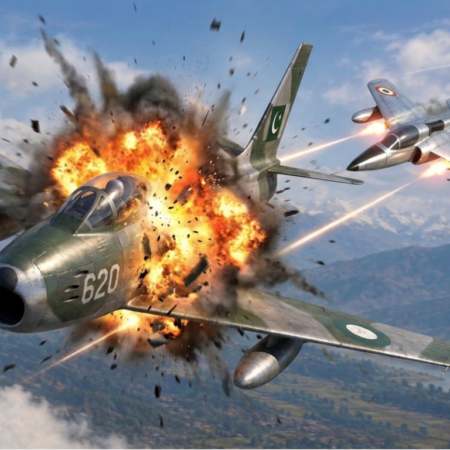
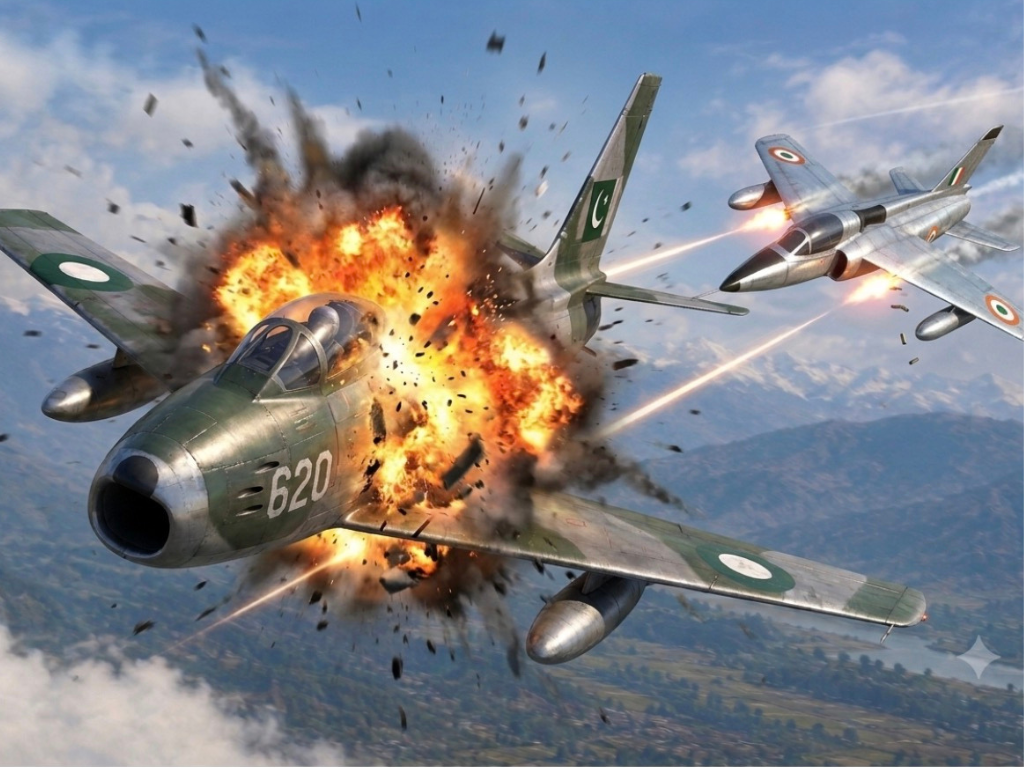
In air combat, size and sophistication can create an advantage—but they do not guarantee victory. During the India–Pakistan wars of 1965 and 1971, the Indian Air Force’s small Folland Gnat repeatedly challenged the American-designed F-86 Sabre, an aircraft with a formidable reputation from the Korean War. The Gnat was not a miracle machine, nor did every engagement end in an uncontested Indian victory. Its record nevertheless became a striking case study in how manoeuvrability, tactics, ground control and pilot skill can narrow a technological gap.
A small aircraft with a sharply defined purpose
The Gnat was designed in Britain by Folland Aircraft under the influence of a post-war question: did every fighter need to become larger, heavier and more complex? The answer offered by the Gnat was a compact, lightweight interceptor that traded equipment and endurance for agility. It was roughly nine metres long, with a wingspan of about 6.7 metres. The single-seat Gnat F.1 was powered by a Bristol Siddeley Orpheus turbojet and carried two 30 mm ADEN cannon. It had no onboard radar and no air-to-air missiles in its original fighter configuration, leaving pilots dependent on visual acquisition, ground-based direction and close-range gunfire.
These omissions were not trivial. Without radar, the Gnat could not independently search for targets at long range; without missiles, it had to close to cannon range; and its limited fuel reduced time on station. Yet its small size and strong manoeuvrability made it difficult to keep in sight during a turning engagement. The aircraft was built around a specific proposition: if it could reach the fight in the right position, it could be dangerous despite its limitations.
Britain ultimately used the Gnat primarily as an advanced trainer and for the Red Arrows display team rather than adopting it as a frontline fighter. India, however, saw a combat role for it. A licence-production agreement signed in 1956 helped establish Gnat manufacture in Bengaluru by Hindustan Aircraft Limited, the predecessor of Hindustan Aeronautics Limited (HAL). The programme was important not only because it supplied aircraft, but because it expanded India’s practical experience in licensed aircraft and engine production.
The opponent: the F-86 Sabre

The North American F-86 Sabre was a swept-wing jet fighter whose reputation had been forged in Korea. Pakistan operated the type in South Asia and benefited from American-origin equipment, training and support. Some Sabres carried AIM-9 Sidewinder missiles, a major threat to aircraft lacking comparable weapons. The Sabre also had radar-ranging gunsights in relevant versions and a more substantial operational ecosystem than the Gnat.
But comparing aircraft by a specification sheet alone can mislead. Performance varies with altitude, speed, fuel load, weapon fit, pilot decisions and the tactical situation. A Sabre could exploit its strengths in some circumstances; a Gnat could make its small visual profile and turning performance count in others. The contest was never simply ‘small versus large’. It was a contest between aircraft, pilots, warning systems, tactics and command decisions.
1965: the Gnat enters the fight
The early days of the September 1965 war exposed the danger of sending older aircraft into combat against a better-equipped opponent. On 1 September, Pakistani armoured forces attacked in the Chhamb sector, and the Indian Army urgently sought air support. Indian Vampires—an older jet design—suffered losses to Pakistani Sabres. The episode underlined the need to match aircraft to the threat and led the Indian Air Force to withdraw the Vampire from daylight combat in that theatre.
The Gnat soon began to demonstrate why it had been retained as a fighter. In the air battles around Chhamb and later over the Lahore sector, Indian pilots engaged Sabres at close quarters. Squadron Leader Trevor Keelor became associated with one of the early Gnat-versus-Sabre successes on 3 September 1965. Accounts of individual engagements differ over whether particular Sabres were destroyed, damaged or managed to return to base, and national wartime claims should be treated cautiously. The broader point is less disputed: the Gnat proved capable of challenging the Sabre, despite the latter’s reputation and missile advantage.
The aircraft’s performance was not flawless. Its cannon could suffer stoppages, and its short endurance placed a premium on timing and ground direction. In a gun-only fight, a weapon failure could erase an otherwise favourable firing opportunity. The Gnat’s successes therefore depended on more than agility: pilots had to conserve ammunition, position themselves carefully and exploit moments when the Sabre pilot lost visual contact.
A captured aircraft—and a contested narrative
One of the most memorable episodes of the 1965 campaign involved Flying Officer Brij Pal Singh Sikand, whose Gnat landed at Pasrur in Pakistan. The transcript describes the aircraft as intact and notes that Pakistan subsequently displayed it as a war trophy. The incident became part of the Gnat’s complicated legend: the same aircraft that had embarrassed Sabres in combat could also be lost through navigational confusion and the pressures of a fast-moving engagement.
This episode is a reminder that military history is not a simple scoreboard. An aircraft captured intact is evidence of an operational loss, but it does not by itself settle the outcome of the type’s wider combat record. Likewise, claims of aerial victories must be evaluated against pilot reports, wreckage, prisoner accounts and later historical research. Indian and Pakistani accounts sometimes diverge on the fate of individual aircraft. A responsible assessment acknowledges those disagreements rather than presenting every wartime claim as settled fact.
Boyra, 22 November 1971: tactics and teamwork
The Gnat’s reputation was reinforced on 22 November 1971, before the full-scale war began on 3 December. In the Boyra sector of East Pakistan, Indian Gnats intercepted Pakistani F-86 Sabres. The engagement is commonly described as a major Gnat success: three Sabres were lost, and Pakistani pilots were captured. The official Indian history of the 1971 war records the interception and the loss of three Sabres.
Boyra illustrates why an aircraft’s lack of onboard radar need not make it helpless. Ground controllers could guide the Gnats toward the target, reducing the time spent searching and helping them arrive at a favourable angle. In the engagement, the Gnats’ ability to approach unseen and attack from close range mattered as much as their manoeuvrability. The lesson is not that ground control can replace every airborne sensor, but that a well-integrated system can compensate for limitations in an individual platform.
The battle also belongs to the larger context of the crisis in East Pakistan, where the political and humanitarian breakdown of 1971 was moving toward war. Air combat over Boyra was not an isolated duel between aircraft types: it formed part of a campaign in which control of the air would shape ground operations and the speed of events in the eastern theatre.
14 December 1971: Nirmal Jit Singh Sekhon over Srinagar
The most enduring human story associated with the Gnat is that of Flying Officer Nirmal Jit Singh Sekhon. On 14 December 1971, Pakistani Sabres attacked Srinagar airfield. Sekhon took off while the airfield was under attack and engaged the raiders in his Gnat. According to the official Param Vir Chakra citation, he hit one Sabre and damaged another before his own aircraft was shot down. He was unable to eject at a safe altitude and was killed.
Sekhon was posthumously awarded the Param Vir Chakra, India’s highest wartime gallantry award. He remains the only Indian Air Force officer to have received it. The citation recognises his courage and determination in the face of overwhelming odds. Accounts differ on the precise outcome of each firing pass, so it is best to distinguish the official award citation from claims that he definitively destroyed two aircraft. What is beyond dispute is the extraordinary decision to take off under attack and engage a numerically superior force.
Sekhon’s story should not be reduced to a claim that one aircraft ‘beat six’ in a neat contest. He faced six Sabres, fought alone for part of the engagement and was ultimately lost. The significance lies in his initiative, flying skill and refusal to abandon the defence of the airfield—not in simplifying a tragic action into an uncomplicated victory.
What made the Gnat effective?
1. Manoeuvrability and visual difficulty
The Gnat’s compact dimensions and turning performance could make it hard for an opponent to keep sight of it in a close fight. Losing visual contact in a dogfight is a serious tactical problem: a pilot cannot reliably attack a target that cannot be located.
2. Ground-controlled interception
Ground radar and controllers could direct the Gnat toward incoming aircraft. This mattered because the Gnat itself lacked radar. It also shows how an air force can build capability through coordination among sensors, controllers, pilots and aircraft, rather than relying on a single platform’s onboard equipment.
3. Pilot training and tactical adaptation
Aircraft characteristics only become combat advantages when pilots know how to use them. The Gnat’s cannon, short endurance and limited sensors demanded disciplined firing, careful fuel management and rapid decisions. Training and tactical learning helped convert a lightweight design into a credible combat aircraft.
4. Matching the platform to the mission
The Gnat was not an all-purpose answer to every air-war problem. Its value was clearest in close-range interception and manoeuvring combat. It was less suited to prolonged patrols or independent long-range searches. The broader lesson is that operational effectiveness depends on matching a platform to the mission, not on assuming that one design can dominate every role.
From the Gnat to the Tejas: the industrial legacy
India’s experience with the Gnat formed part of a longer, uneven journey toward aerospace capability. Licensed production at HAL gave Indian industry experience in manufacturing aircraft and engines, maintaining fleets and supporting operational units. Licensed production is not the same as designing an aircraft independently, but it can develop industrial skills, technical discipline and a base of trained personnel.
The Gnat was later followed in Indian service by the HAL Ajeet, a development of the Gnat, while India pursued other combat-aircraft programmes. Today, the indigenous Light Combat Aircraft Tejas represents a different generation of design, systems integration and industrial ambition. The re-formation of No. 18 Squadron—associated with Sekhon’s legacy—on the Tejas in 2020 provides a symbolic link between the Gnat era and India’s contemporary effort to build and operate home-grown combat aircraft.
The connection should not be overstated: the Tejas is not simply a modern Gnat, and the technologies, missions and operating environment are very different. The continuity is institutional and aspirational—the drive to build domestic expertise, reduce dependence where feasible, and learn from decades of operating foreign-designed and Indian-produced aircraft.
The strategic lesson: capability is a system
The Gnat’s story offers a useful corrective to technology worship. A more advanced aircraft can hold decisive advantages, but combat outcomes are shaped by doctrine, pilot skill, command-and-control, maintenance, weapons reliability, intelligence and the circumstances of each engagement. The Gnat’s limitations were real, and it did not make the Sabre obsolete. Yet it showed that a smaller platform could exploit a narrow set of advantages and impose costs on a stronger opponent.
The story also warns against turning military history into national mythology. Victory claims, aircraft losses and individual engagements should be assessed carefully, especially when official records and later historians disagree. A balanced account can celebrate courage and tactical achievement without pretending that every detail is uncontested.
Ultimately, the Gnat’s legacy rests on three connected achievements: it gave Indian pilots a credible close-combat option against the Sabre; it helped demonstrate the value of integrating aircraft with ground control and tactics; and it contributed to India’s learning curve in aircraft production and sustainment. Its legend was made not by size, but by the combination of a specialised design and the people who learned how to use it.
Britain designed it; India found its combat role
The Folland Gnat was never a perfect fighter. It was short-legged, lightly equipped by the standards of its era and dependent on visual combat. But in the hands of trained Indian pilots, supported by ground controllers and deployed for missions that suited its strengths, it became a formidable adversary. Its encounters with the F-86 Sabre—from the contested air battles of 1965 to Boyra in 1971 and Sekhon’s final engagement over Srinagar—show both the possibilities and the limits of technological asymmetry.
The enduring lesson is not that a small fighter always defeats a larger one. It is that technology becomes combat power only when people, tactics, training and institutions make it so. The Gnat’s reputation as the ‘Sabre Slayer’ grew from that intersection—and its story remains an important chapter in the history of the Indian Air Force and India’s evolving aerospace ambitions.