China’s “Artificial Sun”: A Scientific Breakthrough or an Energy Revolution Still Decades Away?

For decades, nuclear fusion has been described as the “holy grail” of clean energy—a technology capable of providing virtually unlimited electricity without greenhouse gas emissions. Today, China has emerged as one of the world’s leading contenders in this race through its Experimental Advanced Superconducting Tokamak (EAST), popularly known as the “Artificial Sun.”
Recent breakthroughs have once again brought the project into global headlines. But behind the impressive records lies a more nuanced reality: despite remarkable scientific progress, commercial fusion energy remains one of the greatest engineering challenges of the 21st century.
What is China’s Artificial Sun?
The EAST reactor, located in Hefei, Anhui Province, is not a conventional nuclear reactor. Unlike existing nuclear power plants that generate electricity through nuclear fission—splitting heavy atoms—EAST seeks to replicate the process occurring inside the Sun.
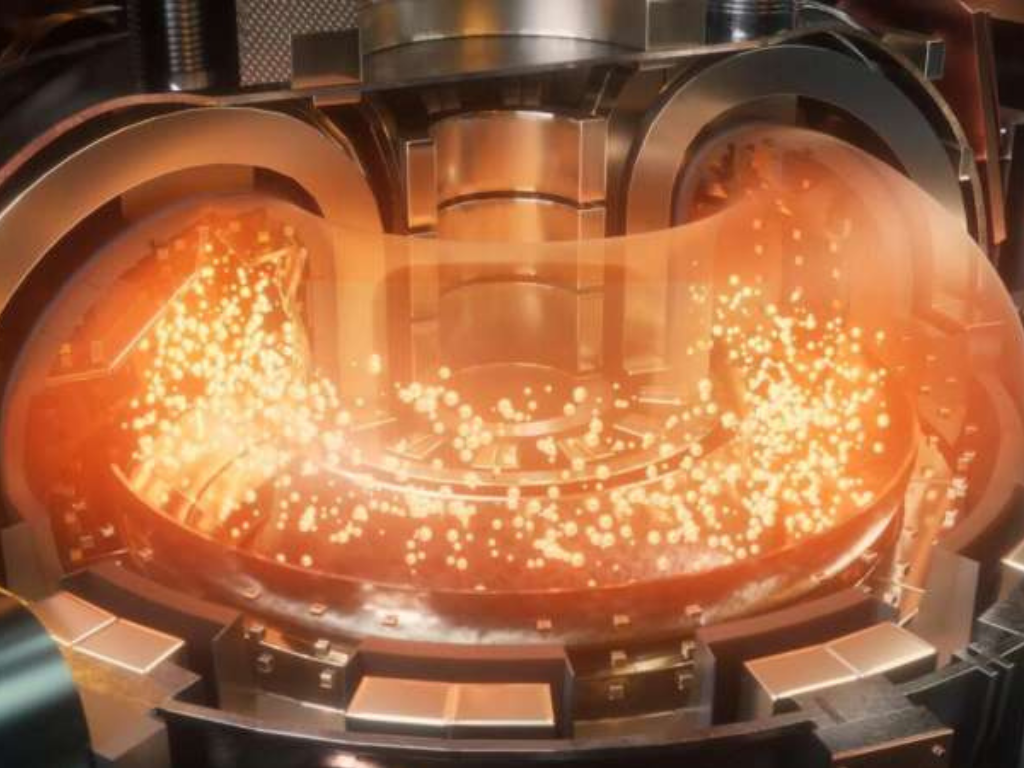
The reactor heats hydrogen plasma to temperatures exceeding 100 million°C, hotter than the Sun’s core, and uses powerful superconducting magnets to confine this plasma inside a doughnut-shaped vessel known as a tokamak. The ultimate objective is to sustain controlled fusion reactions long enough to generate usable electricity.
Unlike popular perception, EAST does not produce electricity today. It is a research platform designed to solve the scientific and engineering problems that stand between laboratory experiments and commercial fusion power plants.
Recent Developments
China’s fusion programme has accelerated significantly over the past two years.
In January 2025, EAST achieved a world record by maintaining high-confinement plasma for 1,066 seconds—nearly 18 minutes. Sustaining plasma for longer durations is essential because future commercial reactors must operate continuously rather than in short experimental bursts.
The momentum continued in 2026.
Researchers announced that EAST had surpassed the long-standing Greenwald density limit, a theoretical ceiling that had constrained plasma density inside tokamaks for decades. Increasing plasma density while maintaining stability is considered one of fusion science’s most difficult challenges, making this achievement particularly significant.
China also completed testing of a 582-ton superconducting toroidal-field magnet, the largest of its kind ever built for a controlled fusion reactor. These magnets are essential because they generate the magnetic fields that keep the ultra-hot plasma from touching the reactor walls. The milestone represents a major advance in China’s engineering capabilities for next-generation fusion systems.
According to Chinese officials, the next-generation experimental fusion facility is expected to be completed by 2027, with the long-term ambition of demonstrating fusion-generated electricity around 2030. These timelines remain aspirational and depend on overcoming substantial technical hurdles.
Why the World is Paying Attention?
The race for fusion energy has become increasingly strategic.
Countries including the United States, China, Japan, South Korea, the United Kingdom and members of the European Union are investing billions of dollars into fusion research. Unlike fossil fuels, fusion fuel is abundant and could dramatically improve long-term energy security.
Growing geopolitical instability—from disruptions in global energy markets to Middle East tensions—has renewed interest in technologies capable of reducing dependence on imported oil and gas. Governments increasingly view fusion as both an energy and strategic technology.
The Challenges Behind the Headlines
Despite impressive records, commercial fusion remains far from reality.
1. It still consumes more energy than it delivers
EAST is an experimental reactor. Running it requires enormous amounts of electricity, and it does not yet generate net electrical power for consumers.
2. Engineering remains extraordinarily difficult
Containing plasma hotter than 100 million°C without allowing it to touch reactor walls requires unprecedented precision. Even minor instabilities can terminate a fusion reaction within seconds.
3. Massive construction costs
Fusion reactors demand superconducting magnets, cryogenic cooling systems, advanced materials and ultra-high vacuum chambers, making them among the most expensive scientific projects ever undertaken.
4. Material limitations
High-energy neutrons produced during fusion gradually damage reactor walls. Developing materials capable of surviving years of continuous operation remains an unsolved engineering challenge.
5. Tritium fuel constraints
Although deuterium is abundant in seawater, tritium is scarce and radioactive. Future commercial reactors will need sophisticated systems to breed their own tritium fuel.
6. Commercial viability remains uncertain
Even optimistic projections place commercial fusion plants many years away. The gap between successful laboratory experiments and economically competitive electricity generation remains substantial.
Does Fusion Solve the Nuclear Safety Problem?
Fusion offers several important safety advantages over conventional nuclear fission.
There is no possibility of a runaway chain reaction or a Chernobyl-style meltdown. If operating conditions become unstable, the plasma simply cools and the fusion process stops. Fusion also produces significantly less long-lived radioactive waste than existing nuclear reactors, although activated reactor components will still require careful handling.
Strategic Implications
China’s rapid progress in fusion research reflects a broader technological strategy aimed at leadership in next-generation industries. Alongside advances in artificial intelligence, semiconductors and quantum technologies, fusion has become another arena where technological leadership could translate into geopolitical influence.
If China succeeds in commercializing fusion earlier than competitors, it would strengthen not only its energy security but also its position in global high-technology manufacturing and scientific leadership.
What next ?
China’s “Artificial Sun” represents one of humanity’s most ambitious scientific projects. Recent achievements—including record plasma confinement, breakthroughs in plasma density, and completion of the world’s largest superconducting fusion magnet—demonstrate genuine progress toward practical fusion energy.
Yet the excitement should be tempered with realism. EAST is still a research experiment, not a commercial power station. The scientific barriers are gradually falling, but the engineering and economic challenges remain immense.
Fusion promises nearly limitless clean energy, but the world is still racing to turn that promise into practical reality. Whether China becomes the first nation to achieve commercial fusion power will be one of the defining technological stories of the coming decade.