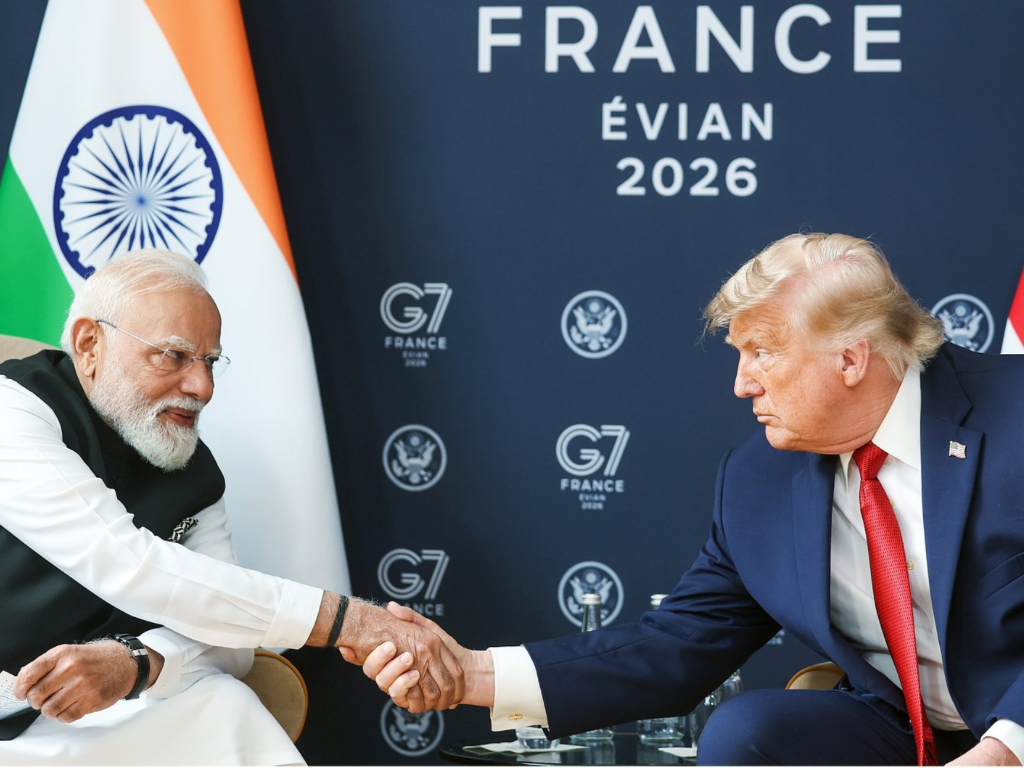
For months, there has been a growing argument that Donald Trump’s approach towards India is doing more than creating a temporary disagreement between New Delhi and Washington. It is creating a trust deficit that could take years to repair.
Recent remarks from India’s External Affairs Minister S. Jaishankar and Finance Minister Nirmala Sitharaman suggest that the problem is no longer limited to tariffs or one difficult round of negotiations. The larger question is whether the strategic trust that India and the United States spent years building can survive Washington’s rapidly changing approach.
Jaishankar’s remarks about the United States becoming a “lonelier power” are particularly significant. Coming from India’s External Affairs Minister, the statement reflects how seriously New Delhi is viewing the transformation in the global strategic environment.
India has historically maintained a complicated but pragmatic relationship with Washington. During the Cold War, the United States developed a close relationship with Pakistan, including during periods when Pakistan was under military rule. India, meanwhile, maintained a strong strategic relationship with the Soviet Union, a relationship whose legacy continues today through India-Russia ties.
The world, however, has changed quite a lot since then.
India is now a major economic and strategic power, the United States remains one of India’s most important partners, and China has emerged as Washington’s principal strategic competitor. In such an environment, India expected the relationship with the US to become deeper and more predictable.
Instead, the Trump administration’s policies have introduced considerable uncertainty.
America’s “radical repositioning”
Jaishankar’s argument about a changing geopolitical landscape is important because Washington’s recent foreign-policy posture has affected not just India but several traditional American partners.
Trump has publicly clashed with leaders and governments across the Western alliance system, while simultaneously pursuing a different approach towards Russia and maintaining an adversarial relationship with China.
From Europe to Asia, traditional assumptions about American foreign policy are therefore being questioned.
For India, however, the issue is not simply whether Washington is becoming more confrontational. The bigger question is what this repositioning means for countries that have invested heavily in building strategic relationships with the United States.
India has cooperated with Washington on defence, technology, trade, critical minerals, supply-chain diversification and the Indo-Pacific. American companies have also built enormous commercial interests in India.
That creates a basic expectation of reciprocity.
India does not expect the United States to give it everything it wants. But New Delhi does expect its strategic importance to be reflected in economic negotiations.
And this is where the trade dispute becomes particularly important.
The India-US trade deal has reached a plateau
Finance Minister Nirmala Sitharaman’s assessment that the India-US trade negotiations have reached a “plateau” highlights the difficulty.
The problem is that negotiations require room for both sides to make concessions. If that space disappears, even technically strong negotiations can become politically difficult.
India’s concern is straightforward: it wants meaningful market access and tariff treatment that allows Indian exporters to remain competitive against countries such as Vietnam, Bangladesh, Indonesia, South Korea, Japan and China.
This is not merely about securing a lower tariff for India. It is about India’s position relative to its competitors.
If Indian products face substantially higher tariffs in the American market than comparable products from competing economies, Indian exporters could lose market share even when their products remain globally competitive.
Therefore, New Delhi has an obvious incentive to wait until Washington’s broader tariff architecture becomes clearer.
Until the United States establishes what tariff structures will apply to other major trading partners, India has limited visibility into what a final bilateral arrangement should look like.
The tariff issue changes the equation
This is where the current numbers become interesting.
India’s exports to the United States have continued to show strength despite the tariff dispute. The increase in exports indicates that trade flows have not immediately collapsed under the current tariff structure. But that does not mean the problem has disappeared. Trade is ultimately sensitive to costs.
If tariffs rise dramatically, the economics of exporting to the American market can change almost overnight.A tariff regime that is manageable at one level can become commercially destructive at another.
Therefore, India’s trade relationship with America cannot be evaluated merely by looking at current export numbers. The real test will be what happens after the United States finalises its tariff policy towards India and other competing exporters.
The trust deficit is bigger than tariffs
Yet tariffs are only one part of the story. Perhaps more damaging is the rhetoric coming from Washington.
When senior American officials travel to India and make statements suggesting that Washington does not want India to replicate China’s economic rise, the message creates a very different impression from the one traditionally associated with the India-US partnership.
India wants to grow. It wants to become a manufacturing hub, expand exports, attract investment and develop technological capabilities. It also wants strategic autonomy.These objectives should not inherently conflict with American interests.
In fact, India’s economic rise can potentially serve American strategic interests by creating an alternative major economic centre in Asia and reducing excessive dependence on China.
That is why statements that appear to question India’s growth trajectory can create unnecessary friction.
A strategic partnership cannot function purely through transactions. It also requires confidence that both sides want the other to become stronger.
India is not asking for charity
There is another fundamental reality that Washington cannot ignore.India is not simply a recipient in the India-US relationship. India is a major market for American technology companies. US firms have significant commercial interests in India, while the two countries cooperate extensively in defence and strategic technology.
India has also become increasingly important to American efforts to diversify supply chains away from China.Therefore, when New Delhi asks for preferential or competitive tariff treatment, it is not necessarily asking for a one-sided concession.
It is negotiating from the perspective of a country that believes its strategic and economic importance should be reflected in the final arrangement.This is where the current deadlock becomes significant.
If Washington wants India to become a larger economic and strategic partner, then economic policy cannot continuously create incentives for India to look elsewhere.
Russia remains the uncomfortable reminder
Jaishankar’s remarks also underline another reality.
India never abandoned its relationship with Russia, even as it simultaneously deepened its relationship with the United States.That is the essence of India’s strategic autonomy.New Delhi does not want to choose between Washington and Moscow simply because one side demands it.
India has consistently pursued relationships according to its own interests.The irony is that pressure from Washington can sometimes strengthen precisely the strategic diversification that American policymakers would prefer India not to pursue.
The more uncertain the relationship with the United States becomes, the more valuable strategic alternatives become for India. That does not mean India is abandoning America. It means India is refusing to become dependent on America. There is an important difference.
The real damage may take years to repair
The most consequential outcome of the current dispute may therefore not be the immediate tariff bill.It may be the erosion of trust.Tariffs can eventually be negotiated. Trade agreements can eventually be rewritten. Governments can change.But once strategic confidence is weakened, rebuilding it takes considerably longer.
India and the United States have spent decades moving from strategic suspicion to strategic partnership. That transformation was not automatic. It required political investment from successive governments in both countries.
If that accumulated trust is damaged by unpredictable trade policies, confrontational rhetoric and shifting strategic signals, repairing the relationship will require more than another round of negotiations. It will require consistency.
Washington still has enormous strategic and economic importance for India. Likewise, India has become too important to the United States to be treated simply as another country in a tariff dispute.
The relationship is therefore unlikely to disappear. But it can change. And that may be the central message behind Jaishankar’s “lonelier power” remark and Sitharaman’s assessment of the trade negotiations.
The question is no longer whether India and the United States need each other.They clearly do. The question is whether Washington and New Delhi can rebuild enough trust to ensure that strategic cooperation is not repeatedly undermined by short-term economic and political confrontation.
For now, the answer remains uncertain.And if the current trajectory continues, repairing the damage may indeed take considerably longer than creating it.