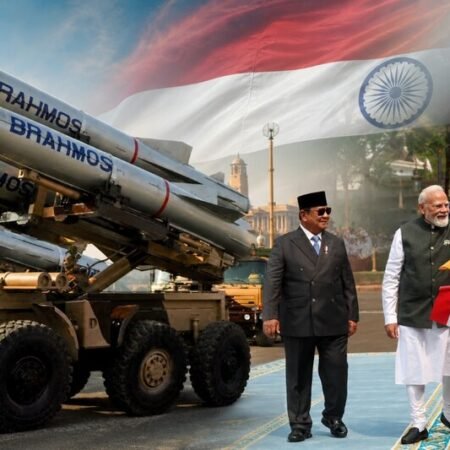
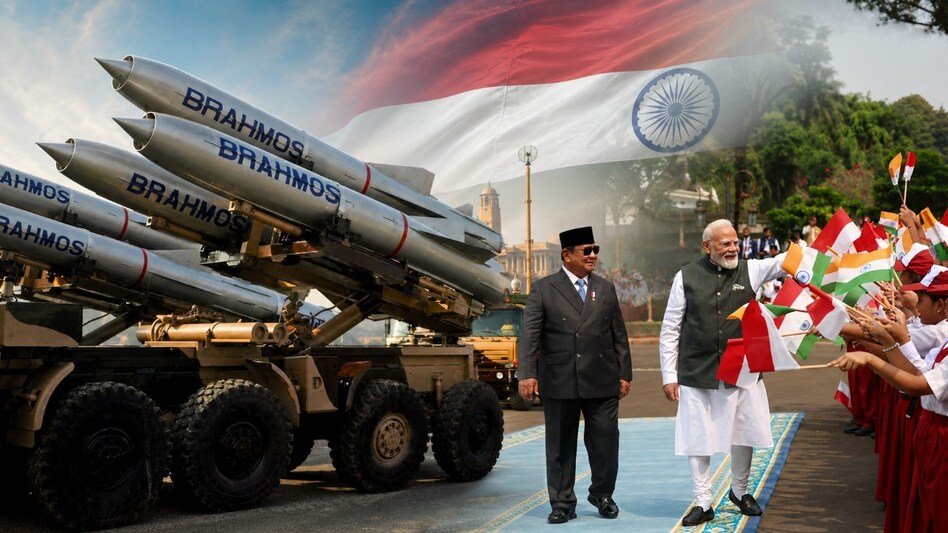

Most people in India know the capabilities of the devastating supersonic Brahmos missile, however few are aware of how New Delhi is now deploying its prime missile power tech to create a massive geostrategic deterrence across the Indian Ocean and beyond.
Known as the “BrahMos Belt”, a strategic concept used by experts to describe India’s expanding network of partnerships involving the export and deployment of the BrahMos supersonic cruise missile to Southeast Asian countries around the South China Sea. This informal arc of coastal and maritime defence capabilities aims to strengthen regional deterrence against aggressive actions of nations treading across international boundaries, particularly in contested waters in the region, while advancing India’s defence diplomacy and export ambitions.
BrahMos, jointly developed by India’s Defence Research and Development Organisation (DRDO) and Russia’s NPO Mashinostroyeniya through BrahMos Aerospace, is one of the world’s fastest operational cruise missiles. It travels at nearly Mach 2.8 to Mach 3, and can be launched from land, sea, air, or (in development) underwater platforms, and is known for its sea-skimming flight profile, high precision, and difficulty of interception. Originally limited to around 290 km for export compliance with the Missile Technology Control Regime, extended-range variants now reach further, with domestic versions progressing toward 450–800 km.
Origins and Core Purpose of the BrahMos Belt
The concept of the Brahmos Belt gained prominence as India shifted from primarily domestic induction of BrahMos to successful exports. The Philippines became the first foreign customer in 2022 with a $375 million deal for three shore-based anti-ship missile batteries focused on coastal defence. Deliveries followed in subsequent years, integrating into Manila’s archipelagic defence plans, including protection of areas like the Luzon Strait and West Philippine Sea.
Subsequent deals with Vietnam (estimated around Rs 5,900 crore / roughly $629 million) and Indonesia (around Rs 1,900 crore for two batteries, or $200–300 million range) have extended the network. Thailand and Malaysia have shown interest, potentially completing a broader chain of overlapping coastal strike capabilities. Experts note that if multiple ASEAN nations operate BrahMos, any navy operating in the South China Sea—including China’s People’s Liberation Army Navy—would need to account for multiple BrahMos-equipped coastlines rather than isolated threats.
The strategy’s stated purposes include:
Strengthening regional maritime deterrence and anti-access/area-denial (A2/AD) capabilities for partner nations facing territorial or maritime disputes.
Enhancing India’s strategic influence and long-term defence relationships through training, maintenance, logistics, and lifecycle support that can last 15–30 years.
Supporting India’s “Make in India” and “Make for the World” goals by boosting defence exports and industrial capacity.
Promoting a more stable Indo-Pacific balance without formal alliances, as emphasised by retired Indian officers involved in the programme
China-Aimed Angles and Deterrent Strategy
While Indian officials and experts stress that the BrahMos Belt is not explicitly designed to target China alone and will not disrupt India-China bilateral ties, its geography and capabilities create clear deterrent effects against Chinese maritime assertiveness in the South China Sea.
The countries involved—the Philippines, Vietnam, and Indonesia—all face direct or overlapping maritime disputes or pressures from Beijing. Their coastlines form a loose triangle or “ring” around key South China Sea chokepoints, shipping lanes, and approaches to critical passages such as the Luzon/Bashi Strait, areas near the Spratly Islands, and routes linking to the Malacca Strait. Shore-based BrahMos batteries provide these nations with credible A2/AD tools that raise the operational costs and risks of Chinese naval, coast guard, or militia activities in disputed zones
Key deterrent elements include:Speed and precision advantage: At nearly Mach 3 with sea-skimming profiles, BrahMos is extremely difficult to intercept. A salvo can overwhelm defences, forcing Chinese Navy vessels operating at extended ranges to factor in high vulnerability once they enter the engagement envelopes of multiple partner coastlines.
Asymmetric equaliser: As described by strategists, BrahMos acts as a “poor nation’s great naval equaliser.” Southeast Asian states cannot match China’s fleet size or blue-water capabilities through expensive warship programmes. Mobile, land-based missile batteries offer a cost-effective way to deny freedom of manoeuvre and complicate amphibious or coercive operations.
Chinese naval forces extending their reach into the South China Sea increasingly enter the arc of these systems. Deployments in the Philippines (covering northern Luzon and Palawan), potential Vietnamese coverage opposite Hainan and central shipping lanes, and Indonesian batteries near southern approaches create overlapping threat zones. This forces Beijing to adjust deployments, increase defensive measures, and accept higher escalation risks.
Signalling and strategic depth: Retired Indian officers note that China has observed BrahMos performance (including its combat use) and must recognise it is dealing with a stronger, more networked India. The belt serves as regional signalling without requiring Indian force projection into the theatre.
Chinese strategic commentary and state media have registered concern. Discussions on Chinese platforms have described the deployments as forming a potential “ring-shaped blockade” or missile encirclement around key South China Sea features.
Analysts in Beijing have called the proliferation a “troublemaker for international security” and argued that India is shrewdly increasing complexity for the Chinese Navy without deploying its own forces. Some responses emphasise that China will counter through enhanced air and missile defences on Hainan, intensified long-range naval training, and continued modernisation, while asserting that a few missile batteries will not overturn overall Chinese maritime advantages.
Philippine officials have explicitly linked BrahMos to “credible deterrence” against China’s expanding presence, noting that it provides anti-access capabilities that reconfigure an aggressor’s operational calculus and raise the costs of grey-zone or coercive actions.
In broader terms, the strategy aligns with India’s Act East policy and informal counter to China’s “String of Pearls” by building a network of capable partners—sometimes described as part of a “Necklace of Diamonds” approach—while remaining short of formal military alliances.
Current Expansion
Exports have accelerated following the missile’s combat use in Operation Sindoor (May 2025), which demonstrated its precision and effectiveness and boosted international confidence. Production has scaled significantly: facilities in Hyderabad, Nagpur, Pilani, and a new one in Lucknow (part of the Uttar Pradesh Defence Industrial Corridor) are increasing output. Indigenous content has risen sharply (boosters, warheads, and other components increasingly made in India by firms like Solar Industries), with goals to cut costs by nearly 20% by 2028 through greater localisation.
Domestically, India continues expanding BrahMos across its own forces:
Army: Multiple regiments for land-attack and border roles.
Navy: Accelerating fleet-wide integration, targeting near-universal deployment on major surface combatants by 2030 (potentially over 200 ships capable of launching the missile). Approvals include more than 220 Extended Range missiles, vertical launch systems on new frigates and destroyers, and retrofits on older vessels.
Air Force: Integration on Su-30MKI fighters (around 40 already equipped), with plans for lighter variants compatible with more aircraft.
Interest has also emerged beyond Southeast Asia, including discussions with countries in West Asia, Latin America, Africa, and even reports of Russian interest in additional systems.
Future Planning and Developments
Looking ahead, the strategy rests on both technological upgrades and broader outreach:
BrahMos-NG (Next Generation): A lighter (around 1.2 tonnes vs. ~2.9 tonnes), smaller-radar-cross-section version with AESA seeker, enabling more missiles per platform (e.g., five on a Sukhoi, eight on land launchers). Targeted for the late 2020s.
Extended-range and specialised variants: Versions approaching 800 km, submarine-launched options (linked to programmes like P75I), and research into hypersonic successors or composite-material designs for reduced weight and enhanced performance.
Production and cost reduction: Higher domestic content, new facilities, and scaled manufacturing to meet rising export and domestic demand (order books reported in the billions of dollars).
Geopolitical expansion: Potential inclusion of more ASEAN partners (Thailand, Malaysia), Gulf nations (UAE, Saudi Arabia, Egypt interest noted), and deeper Indo-Pacific defence ties. Long-term support packages will lock in partnerships.
India also continues domestic fortification, including BrahMos deployments relevant to sensitive corridors and borders.
Significance and Outlook
The BrahMos Belt exemplifies India’s evolution from a major arms importer to a credible exporter of advanced, combat-proven systems. By equipping partners with a high-end, hard-to-counter anti-ship and land-attack capability, India helps raise the costs of maritime coercion in the South China Sea while creating durable strategic linkages. Production scale-up, indigenisation, and variant development aim to sustain this momentum amid growing demand.
Challenges remain, including production capacity matching demand, technology transfer sensitivities inherent in the Indo-Russian joint venture, and the need to balance commercial success with careful diplomacy. Nonetheless, as more countries acquire and operationalise the system, the informal BrahMos network is positioned to become a notable feature of the Indo-Pacific security architecture in the coming decade enhancing deterrence, supporting partner sovereignty, and elevating India’s role as a net security provider and defence partner.