“Orange Plague” Why a Golden Statue of Naked Trump over a weak man is being displayed at the European Parliament ?

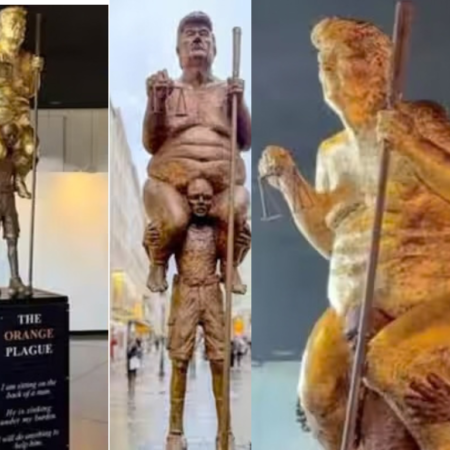
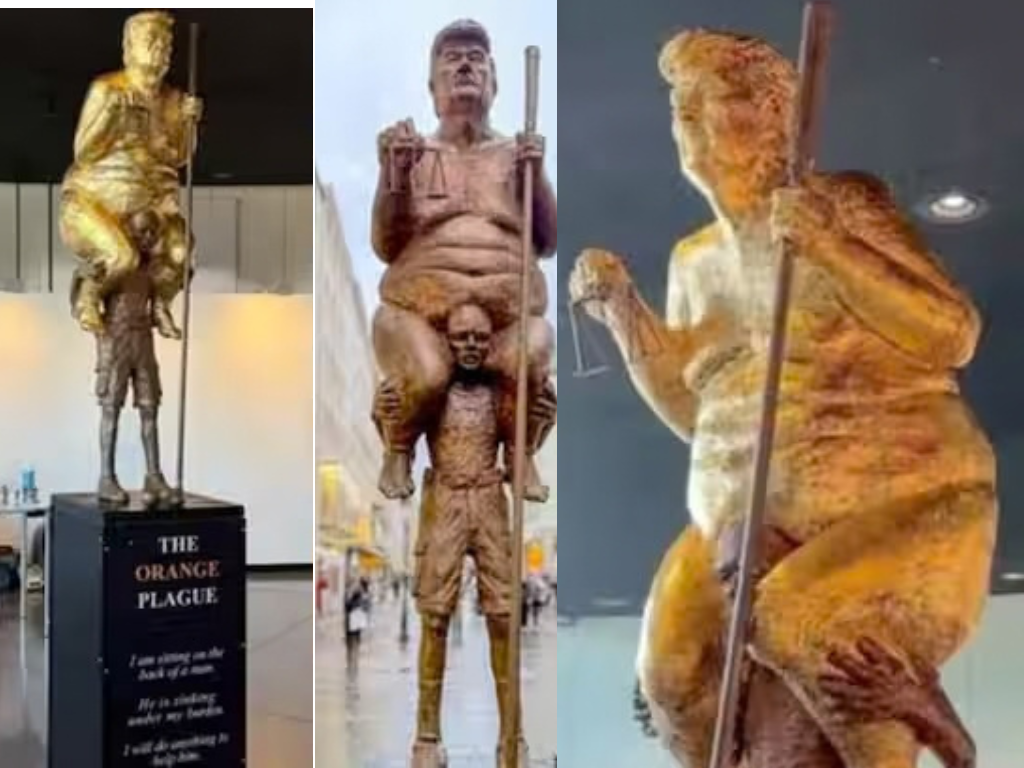
A golden statue depicting US President Donald Trump naked and sitting on the shoulders of a smaller, frail man has appeared inside the European Parliament in Strasbourg, France. Titled The Orange Plague – King of Injustice, the 8.5-foot sculpture was created by Danish artist Jens Galschiøt and covered in 23-carat gold leaf.
The sculpture depicts Trump holding a golf club and a ball resembling the Earth in one hand, while carrying the scales of justice in the other. Its imagery draws on Hans Christian Andersen’s The Emperor’s New Clothes, a story about a ruler who believes himself to be magnificently dressed despite being naked.
The installation is a work of political satire rather than an official declaration by the European Parliament. It was sponsored by Danish politician and Member of the European Parliament Per Clausen and approved through the Parliament’s procedures for cultural exhibitions.
Galschiøt has described the sculpture as a protest against what he considers Trump’s impact on democratic values, climate action and the rules-based international order. The artist has also argued that political leaders should be open to criticism and that satire can challenge the exercise of power.
The statue’s pedestal carries a message attributed to the “King of Injustice”: “I am sitting on the back of a man. He is sinking under my burden. I will do anything to help him. Except stepping down from his back.”
The inscription captures the central metaphor of the artwork: a powerful figure imposing a burden on a weaker individual while presenting himself as a source of assistance.
Why the Statue Has Become a Political Statement
The sculpture’s installation comes amid disagreements between Trump and European leaders over climate policy, international security and the future of transatlantic relations.
Clausen defended the exhibition as an opportunity to debate how political power is exercised. He also raised the question of how Europe could strengthen its capacity for self-defence and reduce its dependence on the United States.
The artwork has attracted attention partly because it places an openly critical depiction of a sitting American president inside a major European political institution. However, its presence should not be interpreted as the official position of all European governments or the European Union.
Galschiøt had previously displayed The Orange Plague at the COP30 climate conference in Brazil and the Munich Security Conference in Germany. The artist also produced miniature versions of the sculpture for distribution as symbols of protest.
Trump’s Image in Europe
The controversy surrounding the statue coincides with reports of unfavourable European public opinion towards Trump. Figures cited in the accompanying commentary put his favourability at approximately 12 per cent in France, 9 per cent in Germany and 4 per cent in Denmark.
These figures point to the importance of distinguishing public attitudes towards an American president from the broader relationship between the United States and its European allies. European countries continue to have strategic, economic and security interests tied to Washington, even when disagreements emerge over particular policies.
The sculpture is also part of a wider history of artistic representations of Trump. In 2016, the activist collective Indecline created nude statues of him under the title The Emperor Has No Balls. In 2024, a 43-foot nude caricature appeared near Las Vegas. Other works have portrayed Trump as Buddha and used imagery associated with religion, political influence and his past association with Jeffrey Epstein.
These installations have employed humour, exaggeration and provocation to comment on Trump’s political persona. The Strasbourg sculpture follows the same tradition, using nudity and gold to represent perceived vanity, privilege and power.
Europe’s Strategic Dependence on the United States
Beyond the symbolism of the statue, the debate over European self-reliance raises a more consequential question: how much freedom does Europe have to pursue its own policies when its security and economic interests remain closely connected to the United States?
The accompanying commentary highlights concerns about American pressure on European energy policy, including claims concerning diesel exports and the release of emergency fuel reserves. It links these concerns to rising fuel prices and the political pressures facing the Trump administration ahead of the US midterm elections.
These claims require independent verification before they can be treated as established policy developments. Nevertheless, energy security and the management of strategic reserves are relevant to the broader discussion about European resilience.
For European governments, reducing vulnerabilities can involve diversifying energy supplies, strengthening domestic industrial capacity, expanding cooperation among European countries and maintaining adequate emergency reserves. In defence, it can involve greater investment in military capabilities and a stronger European role in collective security.
Such measures would not necessarily mean ending cooperation with Washington. Rather, the issue is whether Europe can preserve its ability to make independent decisions when its interests diverge from those of its principal ally.
Beyond Political Satire
The Orange Plague – King of Injustice is a temporary exhibition, not a policy measure. Its significance lies in the debate it has generated about political leadership, democratic values and the use of power.
The statue does not establish a unified European position on Trump, nor does it demonstrate that European governments have reached agreement on strategic independence. It does, however, provide a visible expression of criticism directed at the American president by the artist and the politician who sponsored the exhibition.
The wider debate concerns the relationship between political symbolism and practical policy. Public criticism can communicate dissatisfaction, but questions surrounding defence, energy security and economic dependence ultimately require decisions by governments and European institutions.
The statue’s appearance in Strasbourg therefore places two issues side by side: the freedom to challenge political power through satire and the continuing debate over Europe’s ability to protect its interests in a changing transatlantic relationship